
Category Archives: Business

Updated: The CBOafs (They Really Can't Count)

Barack Obama, Business, Government, Healthcare, Reason, Regulation, Socialism

In trying to sell the viability of BO’s Health plans, the oafs at the Congressional Budget Office (CBOafs) posit at least one scenario that doesn’t wash. Check the tables attached (via the WSJ). The CBOafs would like you to believe that an employer will choose NOT to drop a $10,000 health benefit for a paltry penalty of $750, thus saving $9,250, in the case of a high-valued employee. In an employer’s market??! Where are they living? Have they even surveyed the private sector?

This is, it would seem, a postulate ObamaCare is premised upon. The bastards.
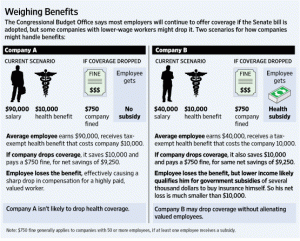
NA-BC960A_BIZHE_NS_20091222215544

Update I (Dec. 23): THEY REALLY CAN’T COUNT. The “CBO has discovered an error in the cost estimate released yesterday,” the correction of which “reduces the degree to which the legislation would lower federal deficits in the decade after 2019,” confessed the Chief CBOaf. The entry, tucked away on the “Director’s Blog,” made select TV headlines today.

Call me simple, but with the prospect of merging one Bill (The House’s) that’s estimated to cost more than $1 trillion over the next 10 years (according to the “nonpartisan” CBOafs) with another (The Senate’s) priced at $871 billion over the next 10 years (CBOafs again)—I’m unclear how the cost curve, as they put it, will be bent.

Updated: Good Versus Bad Loans

Barack Obama, Business, Debt, Economy, Federal Reserve Bank

Steve Bartlett of the Financial Services Roundtable told Judy Woodruff of PBS: “I have never met a small business man who applies for a loan that doesn’t think that he or she is qualified.”

Bartlett’s group represents most of the banks that met with Obama to field the fool’s demand that banks lend for the sake of lending (the practice that helped bring about the financial collapse).

Bartlett: “The fact is you have to do it one loan at a time and make sure it’s a good loan. And that is what we communicated to the president today. We’re setting out to look for ways to make more loans, to increase business lending, but we’re not going to get back into that old habit of making bad loans.”

AND:

“A loan is not capital. … Capital is your own money. A loan is the money that you have to pay back. … There are 8,000 banks out there and 50,000 other non-bank lenders, so it is a competitive marketplace. If someone has a loan that has full cash flow and full collateral, they will be able to get the loan.”

Peter Schiff, on the other hand, isn’t buying anything the bankers claim: “Major investment and commercial banks are not back on their feet,” he notes, “but remain fundamentally insolvent. Their current business model of risk-free speculation depends upon the maintenance of government backstops, the continued availability of cheap money from the Fed, and the use of accounting gimmicks that allow them to conceal losses behind phony assumptions.”

Amity Shlaes, who knows a thing or two about FDR, informs us that “capital strike” is the label “a petulant Franklin Roosevelt” gave to the banks’ refusal to lend:

“Election cycles also contribute to capital strikes. Banks today know that whatever the White House says, it has to stop pouring out the cash eventually, probably after midterms. Banks in the 1930s held onto cash because they knew Roosevelt would stop spending after the 1936 election, and he did.”

“These bankers had been burned. The wary banks reacted by stashing away yet more cash. The result was an unforeseen tightening and less cash in the economy.”

Update: Ron Paul: “The banks seem to be hoarding liquidity now but once these dollars make their way into the economy, hyperinflation and economic chaos will be a real possibility.”

Update II: Bush & Barack Sitting In A T-R-E-E …

Barack Obama, Bush, Business, Economy, Neoconservatism, Regulation, War

Who Does Barack Obama Remind Me Of? BUSH. The indignant protestations from the Republicans notwithstanding, the two parties and potentates are interchangeable.

Dec 11, 2009: “… leaders say they will try to raise the ceiling to nearly $14 trillion as part of a $626 billion bill next week to pay for the wars in Afghanistan and Iraq and other military programs in 2010.”

September 11, 2003: Bush increases the ceiling on a whopping $6.8 trillion national debt.

Pleasing neoconservatives: Bush’s preemptive war doctrine never failed to bring a smile to Bill Kristol’s face. Pursuant to last week’s Nobel War Speech address, Obama too is making Bill warm all over.

Read the “Remarks by the President at the Acceptance of the Nobel Peace Prize” to see why Bill is glowing.

Update (Dec. 15): The two converge on war and on chasing “fat cats” (bar the likes of Barney Frank):

Bush: “The Sarbanes-Oxley Act of 2002, courtesy of the Republican Party, cost American companies upwards of $1.2 trillion. The capital flight it initiated caused the London Stock Exchange to become the new hub for capital markets. Given America’s habit of forcing its habits on others, SOX struck fear into quite a few Liberal Democratic hearts in the House of Lords. Lord Teverson worried about the ‘increasing danger of regulatory creep from American regulators that threatens [Britain’s] own light-touch approach to financial regulation.'”

Barack: “A regulatory tsunami is on its way. ever-increasing regulation, stricter corporate-governance standards and the threat of higher taxes in response to the ballooning deficit. This week the Environmental Protection Agency announced that it considered carbon dioxide to be a dangerous pollutant, raising the spectre of clumsy administrative measures to reduce emissions—a prospect even more terrifying to business than the cap-and-trade scheme currently under consideration in Congress. Meanwhile, hopes of business-friendly reforms to America’s convoluted corporate-tax regime, among other things, have fallen by the wayside. …

‘The concern is pervasive but rather amorphous in the sense that different executives have very different worries,’ says Joe Grundfest, a former member of the Securities and Exchange Commission (SEC) who now runs a ‘boot camp’ at Stanford University for corporate directors. ‘Some fret over tax policy. Others agonise over cap-and-trade, or health-care reform. Many worry about additional corporate-governance regulations. It’s a smorgasbord of corporate neuroses out there.'”

Update II (Dec. 15): Peter Schiff, of course, is hip to the Bush/Barack overlap: “Through aggressive monetary and fiscal stimuli, we are trying to re-inflate a balloon that is full of holes. This was the Bush Administration’s exact response to the 2002 recession. It’s shocking how few observers note the repeating pattern, especially the fact that each crash is worse than the last.”

Update II: Bush & Barack Sitting In A T-R-E-E …

Barack Obama, Bush, Business, Neoconservatism, Regulation, War

Who Does Barack Obama Remind Me Of? BUSH. The indignant protestations from the Republicans notwithstanding, the two parties and potentates are interchangeable.

Dec 11, 2009: “… leaders say they will try to raise the ceiling to nearly $14 trillion as part of a $626 billion bill next week to pay for the wars in Afghanistan and Iraq and other military programs in 2010.”

September 11, 2003: Bush increases the ceiling on a whopping $6.8 trillion national debt.

Pleasing neoconservatives: Bush’s preemptive war doctrine never failed to bring a smile to Bill Kristol’s face. Pursuant to last week’s Nobel War Speech address, Obama too is making Bill warm all over.

Read the “Remarks by the President at the Acceptance of the Nobel Peace Prize” to see why Bill is glowing.

Update (Dec. 15): The two converge on war and on chasing “fat cats” (bar the likes of Barney Frank):

Bush: “The Sarbanes-Oxley Act of 2002, courtesy of the Republican Party, cost American companies upwards of $1.2 trillion. The capital flight it initiated caused the London Stock Exchange to become the new hub for capital markets. Given America’s habit of forcing its habits on others, SOX struck fear into quite a few Liberal Democratic hearts in the House of Lords. Lord Teverson worried about the ‘increasing danger of regulatory creep from American regulators that threatens [Britain’s] own light-touch approach to financial regulation.'”

Barack: “A regulatory tsunami is on its way. ever-increasing regulation, stricter corporate-governance standards and the threat of higher taxes in response to the ballooning deficit. This week the Environmental Protection Agency announced that it considered carbon dioxide to be a dangerous pollutant, raising the spectre of clumsy administrative measures to reduce emissions—a prospect even more terrifying to business than the cap-and-trade scheme currently under consideration in Congress. Meanwhile, hopes of business-friendly reforms to America’s convoluted corporate-tax regime, among other things, have fallen by the wayside. …

‘The concern is pervasive but rather amorphous in the sense that different executives have very different worries,’ says Joe Grundfest, a former member of the Securities and Exchange Commission (SEC) who now runs a ‘boot camp’ at Stanford University for corporate directors. ‘Some fret over tax policy. Others agonise over cap-and-trade, or health-care reform. Many worry about additional corporate-governance regulations. It’s a smorgasbord of corporate neuroses out there.'”

Update II (Dec. 15): Peter Schiff, of course, is hip to the Bush/Barack overlap: “Through aggressive monetary and fiscal stimuli, we are trying to re-inflate a balloon that is full of holes. This was the Bush Administration’s exact response to the 2002 recession. It’s shocking how few observers note the repeating pattern, especially the fact that each crash is worse than the last.”