
Category Archives: Hollywood

Holland Keeps Afloat; Why Can't New Orleans?

America, Europe, Government, Hollywood, Technology

It ought to be called The Anatomy of a Disgrace. The latest word on why the levees of New Orleans failed, faults their design, construction, and maintenance. In shorthand: everything about them!

I have not read the report, however, if it didn’t, it ought to have mandated, first, that the US Army Corps of Engineers be summarily dismissed—and then dismantled. And second, that the job be privatized. And pigs will fly, I know. Since these solutions are a pipedream, let our excuse for an Engineering Corps be forced to visit The Netherlands, and and learn from the masters who designed the great Maeslant Storm Surge Barrier in Hoek van Holland.

You must have heard the saying, “God created the world and the Dutch created the Netherlands.” This is not an exaggeration:

“The name the Netherlands refers to the low-lying nature of the country (nether means low). Its highest point is the Vaalserberg hill in the south east, which reaches 321 meters above sea level. Many areas in the north and west, constituting more than 25% of the total area of the country, are below sea level. The lowest point near Rotterdam is some 6.7 meters below sea level.

I believe New Orleans is only about 3 meters below sea level.

Earlier this month I visited the Maeslant Storm Surge Barrier, a true monument to human ingenuity. Engineers should find the information on this site fascinating. The mechanism is described as follows (I watched the mini-models in action):

“If a water level of 3.00 meters above NAP is anticipated for Rotterdam the Storm Surge Barrier in the New Waterway has to be closed. In these circumstances the Storm Surge Barrier computer – the Command and Support System (Dutch acronym BOS) instructs the Control System (BES) to shut the barrier. The BES implements the BOS’s commands.

In the event of a storm tide, the docks are filled with water, so that the hollow gates start to float and can be turned into the New Waterway. Once the gates meet, the cavities are filled with water and the gates sink to the bottom, thus sealing off the 360 meter-wide opening. After the high water has passed the gates are pumped out and the structure begins to float again. Once it is certain that the next high water will not be another abnormally high one, the two gates are returned to their docks.

When the New Waterway is sealed off it is no longer possible for shipping to pass. The storm-surge barrier will only be closed in extremely bad weather—in probability once every ten years. A test closure will probably be conducted once a year in order to check the equipment. This will be done when there is little shipping. With the rise in sea levels the storm-surge barrier will need to close more frequently in 50 years time, namely once every five years.

Incidentally, CNN subjects us to endless Katrina kvetching from its edgy, newest, girl reporter, Anderson Cooper. But Cooper is no journalist; he’s an instrument in the Oprahfication of the news. Has he done a story on how the Dutch stay afloat? Of course not; why supply your viewer with useful information, when you can continually tug at their heartstrings instead? Or has he deigned to report on how many people died due to the colossal collapse of these Third-World compatible structures? We still don’t know.
Hollywood’s Constant Kvetching

Hollywood

Never again will I be seduced by The New York Review of Books’ professional rates. The Review is an ideological rag; it’s in the pamphleteering business, there to promote a left-liberal political perspective. It offers obtuse critiques of books and art, ever tethered to politics.
Not so the rigorous and generally apolitical Times Literary Supplement. Here’s an appropriately cynical sampler from the TLS. It’s Keith Miller’s review of The Constant Gardener, for which Rachel Weisz won an Oscar:

[I]f you, too, believe that Rachel Weisz can a carry a movie, then The Constant Gardener is for you…
A giant corporation has been testing its wares on desperate locals, drowning in want, and in many cases already dying of AIDS. Since [Weisz’s] idea of deep cover is tying a succession of brightly colored cloths around her ala Lady Hesther Stanhope (to the delight and gratitude of the natives), and loudly barracking corrupt officials at parties, it is not long before the forces of darkness realize she is on their trail, and violence inevitably follows…
There is little or no moral ambiguity… All the colonials are bad, except our hero and heroine. All the black Africans are good, except one token despot glimpsed at a party, and several anonymous machete-wielding thugs whose badness is made to seem conveniently elemental.

Hollywood's Constant Kvetching

Hollywood

Never again will I be seduced by The New York Review of Books’ professional rates. The Review is an ideological rag; it’s in the pamphleteering business, there to promote a left-liberal political perspective. It offers obtuse critiques of books and art, ever tethered to politics.
Not so the rigorous and generally apolitical Times Literary Supplement. Here’s an appropriately cynical sampler from the TLS. It’s Keith Miller’s review of The Constant Gardener, for which Rachel Weisz won an Oscar:

[I]f you, too, believe that Rachel Weisz can a carry a movie, then The Constant Gardener is for you…
A giant corporation has been testing its wares on desperate locals, drowning in want, and in many cases already dying of AIDS. Since [Weisz’s] idea of deep cover is tying a succession of brightly colored cloths around her ala Lady Hesther Stanhope (to the delight and gratitude of the natives), and loudly barracking corrupt officials at parties, it is not long before the forces of darkness realize she is on their trail, and violence inevitably follows…
There is little or no moral ambiguity… All the colonials are bad, except our hero and heroine. All the black Africans are good, except one token despot glimpsed at a party, and several anonymous machete-wielding thugs whose badness is made to seem conveniently elemental.

Cruise And The Psychiatric Shamans

Celebrity, Hollywood, Pseudoscience, Psychiatry, Reason, Science, The Therapuetic State

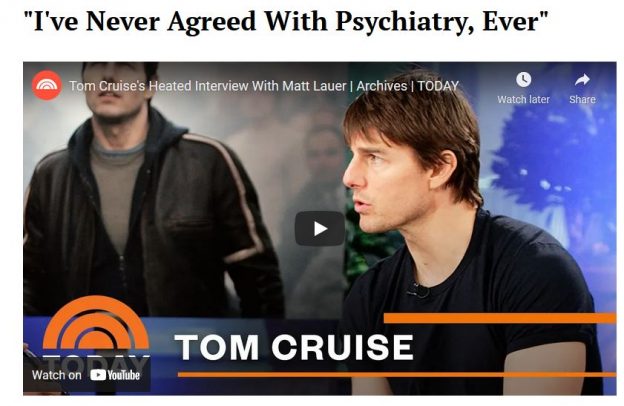
The psychiatric peanut gallery has blasted actor Tom Cruise for insisting correctly that there’s more voodoo to the profession than veracity. Cruise’s instincts are good: “Psychiatrists don’t have a test that can prove that a so-called mental illness is actually organic in origin, I wrote. Rigorous clinician —members of the Society for a Science of Clinical Psychology come to mind —concede that drawing causal connections between “mental illness” and “chemical imbalances” is impossible. That prescription medication often helps misbehaved or unhappy individuals is no proof that strange behavior is an organic disease —placebos or cognitive-behavioral therapy, for example, are as effective.

The shameful shamans depend for their livelihood on diseasing every aspect of behavior (and especially bad behavior). And they evince no qualms about “junking free will, responsibility, and agency for an unproven biological determinism, riddled with logical, factual, and moral infelicities. Cruise, of course, is not the most eloquent spokesman. Actress Kelly Preston is. Her arguments against Ritalin are lucid.

Male biopsychology has been demonized in the schools. As I explained in Broad Sides, boys are boisterous. They are also “naturally predisposed to competition. But a “progressive,” public-school system, populated by female feminists, forces boys to conform to the feminist consensus about appropriate male behavior. One consequence of the last is that instead of challenging, disciplining, and harnessing their energies, boys are often medicated with Ritalin. Cruise, however, ought to have arrived at his perspective not via Scientology, but by studying the works of Thomas S. Szasz, MD, the genius who delivered the deductive death knell to the psychiatric house of cards.