
The Antiwar Radical Left

Left-Liberalism And Progressivisim, War

Could there be a more incoherent and contemptible coalition than the one that convened to protest the war in Iraq? Hardly. No self-respecting libertarian (especially the rightists among us) would be caught dead among a crowd of cheering faux revolutionary socialists and other malcontents, many of whom are probably in the country illegally, judging from their English, or lack thereof.

Speakers for A.N.S.W.E.R, which stands for Act Now to Stop War & End Racism, were Al Sharpton, Congresswoman Cynthia McKinney, and representatives from the United Farm Workers of America, the Alliance for a Just and Lasting Peace in the Philippines, the Socialist Front of Puerto Rico, the Nicaragua Network, the Community Labor Union of New Orleans, Mexicanos Sin Fronteras (?), the Teamsters Black Caucus, and a lone Palestinian activist claiming to have been “framed cointelpro-style,” whatever that means. That decent Americans have jobs to attend may explain why none was seen for miles on end. No, these are not the natural allies of libertarians. Would that there was a respectable, antiwar movement libertarians could get behind, but there isn’t.
No-fault Forgiveness is Fatal

Christianity, Judaism & Jews, Psychology & Pop-Psychology, The Zeitgeist

…Christian forgiveness is… contingent on the sinner’s repentance, and can be granted only by the one sinned against, and not by the various proxies of popularity. Instant expiation flows more from the values of the 1960s than from any doctrinal Christian values…

The excerpt is from my new WorldNetDaily column, No-fault Forgiveness is Fatal. Feel free to comment.

UPDATED (12/8/2023): Monopolizers And Flyters (November 23, 2005)

Culture, English, Intellectualism, Intelligence, Literature, Media, The Zeitgeist

On the flyting that flew between the two, Christopher Hitchens and George Galloway

Who monopolizes the market place of ideas in the Guardian’s view? The answer is assorted activists, liberal-leftists, statists, feminists, and other lightweights. Read the paper’s top 100 intellectuals and tell me it doesn’t distress.

I don’t profess to have heard of all the characters on the list. Far from it. But of those I recognize, I guess I’d go with German philosopher Jurgen Habermas. This is not to say I endorse his views or all his influences (the unlovely Theodor Adorno comes to mind). But this is not about agreeing with a thinker, only acknowledging his place on this list.

I’d also go with Pope Benedict XVI, and the marvelous Australian art critic Robert Hughes whose profundity, knowledge, and critical faculties are a credit to his Jesuit teachers.

I see Newsweek‘s wishy-washy Fareed Zakaria is considered an intellectual giant. Woe is me! Amos Oz is a popular writer (and not a good one when compared with Meir Shalev or Shy Agnon), but hardly one of the top intellectuals around. But if one is of the Left, one has an advantage in the selection process.

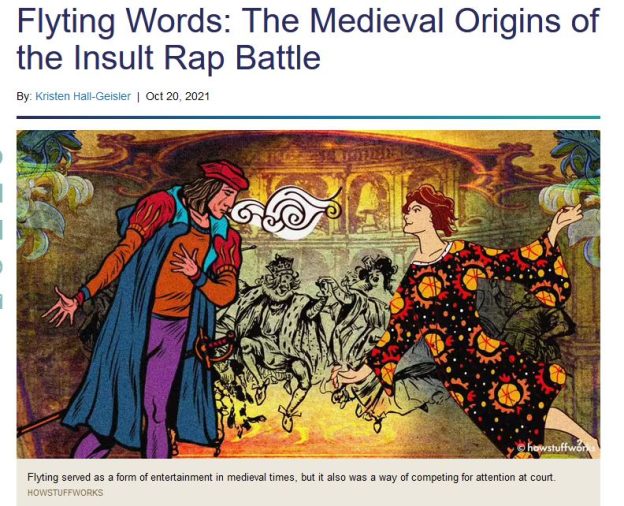
Now hold your horses, will you, because I also admire Christopher Hitchens as a stylist, conversationalist, and an extraordinary flyter. What is flyting, you ask? It’s an ancient Scottish form of invective, a true master of which is the MP George Galloway. I don’t care for his or Hitchens’ ever-shifting views, but I loved the flyting that flew between the two. Galloway called Hitchens a drink-sodden ex-Trotskyist popinjay. Hitchens responded over the pages of an august publication by likening the lickspittle praise Galloway once bestowed on him to spittle flung in place of argument. Later on, the two dueled deliciously on C-Span, where, I’m afraid, Hitchens proved his uncontested superiority in this spontaneous rhetorical art.

Neoconservatives, Reality, And Religious Relativism

Islam, Neoconservatism, Religion

In Get With The Global Program, Gaul, I mention a book with which a number of prominent neoconservatives seem enthralled. Olivier Roy, the author of Globalized Islam: The Search for a New Ummah, draws parallels between radical Islamists and the broader movement of born-again Christians. You heard me. If that makes you shake in your boots (I’m being cynical, of course. Would that the asinine analogy held; we’d be safe), thank your lucky stars. The author believes these Islamic revivalists are doomed to become “a remote, detached community, like the Hasidic Jews and the Exclusive Brethren.” If only the comparison worked. If I were able to wave a magic wand so that born-again Christians and Exclusive Brethren usurped Islamists in the world, I’d do it in a heart beat. Islamism, sadly, is said to have hundreds of millions of active adherents, who do not come in peace. Still. at least two of the neoconservatives I cite in the column dig the book’s religious relativism. Is that significant?
The author, Roy, also sees Islamic radicalism as a revolt against—and a sign of—rapid acculturation, triggered by contact with the West. Islam, apparently, is in the throes of modernization; its atavism is actually advancement in disguise. Neoconservatives don’t care for reality, and they are anything but uncreative when it comes to subverting it. Thus they are in agreement when evidence against a theory is cast as evidence for a theory, as it is in this book. Like magpies to trash, they are also (at least these two) drawn to superficially clever ideas which are not truly insightful because their relationship to reality is at best tangential.