Category Archives: Democrats

Co-op Or Co-optation?

Barack Obama, Democrats, Healthcare, Individualism Vs. Collectivism, Regulation, Republicans, Socialism

As members of the two-party monopoly come together to hammer out a “compromise” on how best to send the health care we have to hell in a handcart, I thought you ought to know a bit about the co-op option; it is, after all, the buzzword being bandied about to replace the less-than soothing “public option” phrase. A co-op is “simply government-run health insurance by another name.” Over to Cato’s Michael D. Tanner:

“Now, if this was really going to be a co-op like rural electrical co-ops or your local health-food store — owned and controlled by its workers and the people who use its services — it would be a meaningless but harmless diversion. America already has some 1,300 insurance companies, so it’s hard to see what one more would add, but it would be unlikely to do much harm.

But these aren’t true co-ops. The members wouldn’t choose its officers — the president would. Plus, the secretary of Health and Human Services would have to approve its business plan, and thus could force it to offer whatever benefits, premiums and reimbursement schedules Washington wants. Finally, the federal government would provide start up, and possibly ongoing, subsidies.

[This is a] ‘co-op’ run by the federal government, under rules imposed by the federal government and with federal funding…

The Senate compromise also drops the job-killing employer-mandate that businesses provide their workers with health insurance or pay a penalty — and substitutes a more regressive employer mandate.

The compromise would have no specific mandate for employers to provide insurance. But any employer who failed to do so would have to pay the cost of all subsidies that the government provides his or her workers to help them pay for insurance on their own.

It is hard to see how this is different from any other employer mandate — except that it will hurt low-wage workers most.

Business owners care about the total cost of hiring a worker, not how that cost is apportioned between wages, taxes, health insurance or other benefits. If they have to pay the cost of subsidizing health insurance for their workers, employers will simply offset the added cost by lowering wages, reducing future wage increases, reducing other benefits (such as pensions), cutting back on hiring, laying off current workers, shifting workers from full-time to part-time or outsourcing.

It will ultimately be the worker who pays the subsidy’s cost. The government will be giving the worker a subsidy with one hand, and taking it back with the other. Does that make sense for any reason other than ‘compromise?'”

The complete Tanner piece here.

Michael D. Tanner is a Cato Institute senior fellow and the author of Healthy Competition: What’s Holding Back Health Care and How to Free It.

Updated: Barbara Boxer Speaks Down To Head Of Black Chamber Of Commerce

Business, Democrats, Left-Liberalism And Progressivisim, Race, Racism, Reason

Democrat Barbara Boxer takes a slow, labored, condescending tone with Harry Alfred, Head Of the Black Chamber Of Commerce. The Senator also makes sure that the testimonies she produces to counteract his are all from black groups. Watch Alfred deftly nail her for appealing to his race rather than to his facts. The annoyance in this little vingette is that only a black or Latin person could hope to get away issuing a similar challenge. And: there are very few such crusaders around.

Update (July 18): John Danforth is absolutely right: Mr. Alfred is locked in a performative contradiction. He is a participant in the discussion in his capacity as a representative of a racial organization, yet he objects when his data is discarded and his race addressed instead. Still, beggars can’t be choosy. Truth is in such short supply that we must welcome it even when it comes from imperfect, self-serving sources.

Update III: Obama’s Route To Economic Revival (A Stake Through The Heart Of The Economy)

Barack Obama, Debt, Democrats, Economy, Healthcare, Media, Socialism

A straitjacket is where this man and his followers belong. And where Bush before him should have been placed. For as much as the beaus and bimbos of FoxNews and their loyalists wish to forget, Bush paved the way for Barack’s Bacchanalia—“The unconstitutional campaign finance-reform bill and ‘Sarbanes-Oxley Act’ (a preemptive assault on CEOs and CFOs, prior to the fact of a crime); the various trade tariffs and barriers; the Clintonian triumph of triangulation on affirmative-action; the collusion with Kennedy on education; the welfare wantonness that began with a prescription-drug benefit that would add trillions to the Medicare shortfall, and culminated in the Kennedy-countenanced ‘New New Deal’ for New Orleans, for which there was no constitutional authority; the gold-embossed invitation to illegals to invade, and the ‘camouflaged amnesty'”—Barack wishes he’d done all this, but these were Bush’s babies.

Back to the bastard du jour : The New York Times editorializes approvingly on what Obama’s health care “reform” will accomplish:

It will “require virtually all Americans to carry health insurance or pay a penalty. And it would require all but the smallest businesses to provide health insurance for their workers or pay a substantial fee. It would also expand Medicaid to cover many more poor people, and it would create new exchanges through which millions of middle-class Americans could buy health insurance with the help of government subsidies. The result would be near-universal coverage at a surprisingly manageable cost to the federal government.

The nonpartisan Congressional Budget Office estimates that by 2015, 97 percent of all residents, excluding illegal immigrants, would have health insurance. The price tag for this near-universal coverage was pegged by the budget office at just more than $1 trillion over 10 years — at the low-end of the estimates we’ve heard in recent weeks.

The legislation would pay for half that cost by reducing spending on Medicare, a staple of all reform plans. It would pay for the other half by raising $544 billion over the next decade with a graduated income surtax on the wealthiest Americans: families with adjusted gross incomes exceeding $350,000 and individuals making more than $280,000.” …

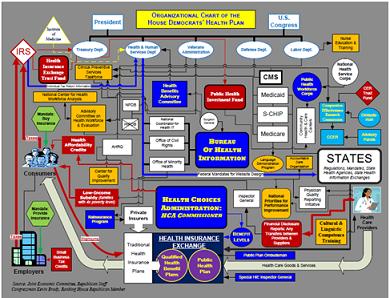
Update I: Republicans on the Joint Economic Committee (led by Rep. Kevin Brady (R-TX), who, as far as I know, did less than nothing to highlight the evils of their Boy Bush’s prescription drug program, have developed the following organizational chart to illustrate the efficiencies built into to the Democrats’ healthscare politburo. Since the image, never the program, is quite small, check it out here.
HC

Update II (July 17): “In total, CBO estimates that enacting [Obama’s healthscare) provisions would raise deficits by $1,042 billion over the 2010-2019 period.” But the CBO and the JCT hope that the net increase in the federal budget deficit of enacting H.R. 3200 will be only a meager $239 billion over the 2010-2019 period. That’s because of some “savings” the Act affords.

“That estimate reflects a projected 10-year cost of the bill’s insurance coverage provisions of $1,042 billion, partly offset by net spending changes that CBO estimates would save $219 billion over the same period, and by revenue provisions that JCT estimates would increase federal revenues by about $583 billion over those
10 years.”

Douglas W. Elmendorf, Director of the CONGRESSIONAL BUDGET OFFICE, who conducted the analysis of “H.R. 3200, America’s Affordable Health Choices Act of 2009,” summarizes the Act’s mandates:

The legislation would establish a mandate to have health insurance, expand eligibility for Medicaid, and establish new health insurance exchanges through which some people could purchase subsidized coverage. The options available in the insurance exchange would include private health insurance plans as well as a public plan that would be administered by the Secretary of Health and Human
Services. The specifications would also require payments of penalties by uninsured individuals, firms that did not provide qualified health insurance, and other firms whose employees would receive subsidized coverage through the exchanges. The plan would also provide tax credits to small employers that contribute toward the cost of health insurance for their workers.

I must say, I’m quite impressed with the CBO. Just the facts, ma’am.

Update III (July 18): Warns economist Peter Schiff: “the economy is walking dead anyway, and this measure is the equivalent of a stake through the heart.” From “Prescription for Disaster”:

“[T]taxing the rich to pay for health care for the uninsured is the wrong way to think about tax policy and is an unconstitutional redistribution of wealth. While the government has the constitutional power to tax to “promote the general welfare,” it does not have the right to tax one group for the sole and specific benefit of another. If the government wishes to finance national health insurance, the burden of paying for it should fall on every American. If that were the case, perhaps Congress would think twice before passing such a monstrosity.

In the second place, the bill is just plain bad economics. For an administration that claims to want to create jobs, this bill is one of the biggest job-killers yet devised. By increasing the marginal income tax rate on high earners (an extra 5.4% on incomes above 1 million), it reduces the incentives for small business owners to expand their companies. When you combine this tax hike with the higher taxes that will kick in once the Bush tax-cuts expire, and add in the higher income taxes being imposed by several states, many business owners might simply choose not to put in the extra effort necessary to expand their businesses. Or, given the diminishing returns on their labor, they may choose to enjoy more leisure. More leisure for employers means fewer jobs for employees.

More directly, mandating insurance coverage for employees increases the cost of hiring workers. Under the terms of the bill, small businesses that do not provide insurance will be required to pay a tax as high as 8% of their payroll. Since most small businesses currently could not afford to grant 8% across-the-board pay hikes, they will have to offset these costs by reducing wages. However, for employees working at the minimum wage, the only way for employers to offset the costs would be through layoffs.”

Read the complete column on Taki’s.

Update III: Obama's Route To Economic Revival (A Stake Through The Heart Of The Economy)

Barack Obama, Debt, Democrats, Healthcare, Media, Socialism

A straitjacket is where this man and his followers belong. And where Bush before him should have been placed. For as much as the beaus and bimbos of FoxNews and their loyalists wish to forget, Bush paved the way for Barack’s Bacchanalia—“The unconstitutional campaign finance-reform bill and ‘Sarbanes-Oxley Act’ (a preemptive assault on CEOs and CFOs, prior to the fact of a crime); the various trade tariffs and barriers; the Clintonian triumph of triangulation on affirmative-action; the collusion with Kennedy on education; the welfare wantonness that began with a prescription-drug benefit that would add trillions to the Medicare shortfall, and culminated in the Kennedy-countenanced ‘New New Deal’ for New Orleans, for which there was no constitutional authority; the gold-embossed invitation to illegals to invade, and the ‘camouflaged amnesty'”—Barack wishes he’d done all this, but these were Bush’s babies.

Back to the bastard du jour : The New York Times editorializes approvingly on what Obama’s health care “reform” will accomplish:

It will “require virtually all Americans to carry health insurance or pay a penalty. And it would require all but the smallest businesses to provide health insurance for their workers or pay a substantial fee. It would also expand Medicaid to cover many more poor people, and it would create new exchanges through which millions of middle-class Americans could buy health insurance with the help of government subsidies. The result would be near-universal coverage at a surprisingly manageable cost to the federal government.

The nonpartisan Congressional Budget Office estimates that by 2015, 97 percent of all residents, excluding illegal immigrants, would have health insurance. The price tag for this near-universal coverage was pegged by the budget office at just more than $1 trillion over 10 years — at the low-end of the estimates we’ve heard in recent weeks.

The legislation would pay for half that cost by reducing spending on Medicare, a staple of all reform plans. It would pay for the other half by raising $544 billion over the next decade with a graduated income surtax on the wealthiest Americans: families with adjusted gross incomes exceeding $350,000 and individuals making more than $280,000.” …

Update I: Republicans on the Joint Economic Committee (led by Rep. Kevin Brady (R-TX), who, as far as I know, did less than nothing to highlight the evils of their Boy Bush’s prescription drug program, have developed the following organizational chart to illustrate the efficiencies built into to the Democrats’ healthscare politburo. Since the image, never the program, is quite small, check it out here.

HC

Update II (July 17): “In total, CBO estimates that enacting [Obama’s healthscare) provisions would raise deficits by $1,042 billion over the 2010-2019 period.” But the CBO and the JCT hope that the net increase in the federal budget deficit of enacting H.R. 3200 will be only a meager $239 billion over the 2010-2019 period. That’s because of some “savings” the Act affords.

“That estimate reflects a projected 10-year cost of the bill’s insurance coverage provisions of $1,042 billion, partly offset by net spending changes that CBO estimates would save $219 billion over the same period, and by revenue provisions that JCT estimates would increase federal revenues by about $583 billion over those
10 years.”

Douglas W. Elmendorf, Director of the CONGRESSIONAL BUDGET OFFICE, who conducted the analysis of “H.R. 3200, America’s Affordable Health Choices Act of 2009,” summarizes the Act’s mandates:

The legislation would establish a mandate to have health insurance, expand eligibility for Medicaid, and establish new health insurance exchanges through which some people could purchase subsidized coverage. The options available in the insurance exchange would include private health insurance plans as well as a public plan that would be administered by the Secretary of Health and Human
Services. The specifications would also require payments of penalties by uninsured individuals, firms that did not provide qualified health insurance, and other firms whose employees would receive subsidized coverage through the exchanges. The plan would also provide tax credits to small employers that contribute toward the cost of health insurance for their workers.

I must say, I’m quite impressed with the CBO. Just the facts, ma’am.

Update III (July 18): Warns economist Peter Schiff: “the economy is walking dead anyway, and this measure is the equivalent of a stake through the heart.” From “Prescription for Disaster”:

“[T]taxing the rich to pay for health care for the uninsured is the wrong way to think about tax policy and is an unconstitutional redistribution of wealth. While the government has the constitutional power to tax to “promote the general welfare,” it does not have the right to tax one group for the sole and specific benefit of another. If the government wishes to finance national health insurance, the burden of paying for it should fall on every American. If that were the case, perhaps Congress would think twice before passing such a monstrosity.

In the second place, the bill is just plain bad economics. For an administration that claims to want to create jobs, this bill is one of the biggest job-killers yet devised. By increasing the marginal income tax rate on high earners (an extra 5.4% on incomes above 1 million), it reduces the incentives for small business owners to expand their companies. When you combine this tax hike with the higher taxes that will kick in once the Bush tax-cuts expire, and add in the higher income taxes being imposed by several states, many business owners might simply choose not to put in the extra effort necessary to expand their businesses. Or, given the diminishing returns on their labor, they may choose to enjoy more leisure. More leisure for employers means fewer jobs for employees.

More directly, mandating insurance coverage for employees increases the cost of hiring workers. Under the terms of the bill, small businesses that do not provide insurance will be required to pay a tax as high as 8% of their payroll. Since most small businesses currently could not afford to grant 8% across-the-board pay hikes, they will have to offset these costs by reducing wages. However, for employees working at the minimum wage, the only way for employers to offset the costs would be through layoffs.”

Read the complete column on Taki’s.