Category Archives: Literature

‘Les Misérables’: Lessons Lost, Great Literature Defiled

Art, Celebrity, Film, Hollywood, Human Accomplishment, Intellectual Property Rights, Literature, Pop-Culture, The State

The musical is a loathsome form of entertainment. To debase a great literary work like “Les Misérables” by putting Victor Hugo’s words to catchy, schmaltzy jingles, belted out by Hollywood starlets—this reflects on the miserable state of the culture.

Not that I follow the Golden Globes Hollywood awards itself, but I believe the production called “Les Misérables” was nominated in the “best musical or comedy” category.

It’s quite probable that the self-reverential (and self-referential) crowd involved in the “Les Misérables” production had not read or understood the book.

One Fox News anchor mentioned that this song-and-dance was based on a book written in the 1600s. “Les Misérables” was published in 1862. I doubt Victor Hugo was 200 plus at the time of publication.

As a child, I read “Les Misérables”; Harry Potter type literature was not around (or rather, not in-vogue) to contaminate the mind and the imagination with poorly written phantasmagorical folderol. There is nothing like an historical novel penned by a master, to both teach and excite the imagination.

I do not recognize the book I read way back, in the gush and tosh being disgorged in pixels and on paper about “Les Misérables” by Victor Hugo. I’m sticking to the version I remember.

The “Les Misérables” I read as a kid was about France’s unfathomably cruel and unjust penal system, and the prototypical obedient functionary who worked a lifetime to enforce the system’s depredations.

A similar power (Uncle Sam) and its enforcers recently hounded Aaron Swartz to death. (As a lefty, Swartz would not have defended my rights to be left alone by government, but then we libertarains are not like them. And more of us (libertarians) than them (leftists) understand that “Patents And Copyrights Undermine Private Property.”)

UPDATE III: Botching English (‘Creative’ Is NOT A Noun)

America, Education, English, Literature

Bill O’Reilly has a ludicrous segment on The Factor, where he pretends to introduce his listeners to English words that he supposedly uses.

Last week he introduced the word “chimera,” in which he pronounced the “ch” as you would in “chimp.”

Having actually used this lovely word before I was convinced that the “ch” was pronounced as a “k.” And so it is.

Oh, BO also habitually conjugates incorrectly, saying “laying around” instead of “lying around” in his “Talking Points.” A lot of American writers do that.

I recall that when he was on WND, in the early 2000s, O’Reilly would make this same conjugation error (it drives me to drink), and I’d drop him a polite note. He never replied, but he quickly fixed the mistake. (Myself, I thank my readers profusely when they save me from myself, as they often do, and request that they keep their eyes peeled for any future faux pas.)

Another common error, in enunciation, this time, is “macabre.” The Americanized dictionary support the locals’ hideous habit of saying “macabra.” Sorry. The “re” in “macabre” is silent.

Still on enunciation: “PundiNts.” Even Hillary Clinton inserts an “n” between the “i” and the “t” when pronouncing the word “pundit.” Why?

“Flaunting” laws instead of “flouting” them is especially infuriating. When a politician uses “flaunt” instead of “flout,” as Colin Powell once did, the ultimate penalty should be exerted.

Today (1/3/213) I ran for cover as Bob Costa, National Review’s youthful editor, spoke about a GOP revolt against House Speaker John Boehner. Costa said the following on the Kudlow Report:

“… if he lost 17 Republican votes that means he would have went to a second ballot.”

Costa should have been flogged for not saying, “He would have GONE.” (Although nobody would know why he was being flogged.)

Together, let’s conjugate the verb to “go,” Mr. Costa. “I am going. I will go. I went. I have previously gone. I had gone. I would have gone.”

My first language is Hebrew. However, I like to think that thanks to the drilling I was given, in Israel, by my old English teacher (a Yekke), I can conjugate my verbs.

When it comes to spelling, however, I am lost without Windows.

UPDATE I (Jan. 3): MERCER MISTAKES. One of my wonderful readers has already corrected my TV mistakes in the article, now on RT. He writes: “You had a typo.
Jon Hamm, not John Han. Also, ‘Mad Men’ is an AMC show, not HBO.”

UPDATE II (Jan. 6): RICHARD BURTON. The great Richard Burton, both chivalrous and brilliant, said: “I am as thrilled by the English language as I am by a lovely woman.”

UPDATE III (May 15): ANOTHER NO-NO. “Creative” is not a noun. Don’t call yourself a “creative.” You will stand out not for your creativity (a noun), but for your pretentiousness.

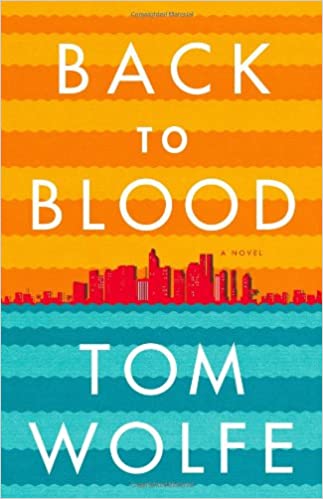
Tom Wolfe’s Big, Bad Book

America, Celebrity, English, Intelligence, Literature, Sex

A careful guardian of the English language Tom Wolfe is not. The infelicities of style and substance in the novelist’s latest book are summed up by Stephen Abell, in the Times Literary Supplement’s November 9, 2012 issue. Abell’s verdict about the door-stopper, Back to Blood: “While it is big, it is not particularly clever”:

…as we struggle through his fourth blockbuster, Back to Blood, we begin to reflect that size, in literature as in life, is not everything. We can at least confidently point to some of the products of Wolfe’s recent cramming …

… [Wolfe] direct[‘s] much of our attention beneath the sheets. Not that sex in Back to Blood goes on merely in the bedroom. In one ill-conceived set-piece, Norman and Magdalena attend a regatta, which becomes a floating orgy with pornography being displayed on the giant sails of some of the boats (complete with rather startling “labia majorae three times as big as the entrance to the Miami Convention Center”).

Sex unquestionably brings out some of the flaws in Wolfe’s prose. For example, its effortfully mimetic approach, where the writing enacts the sounds it is describing. This is from a superfluous trip to the “Honey Pot” (an unimaginative strip club), where Wolfe wants to leave us in no doubt about the pole-straddling gyrations of the woman on stage: “BEAT thung CROTCH thung TAIL thung CRACK thung PERI thung NEUM thung”. Or its obsession with transcribing sounds to needless effect (which creates sentences that make it look as if the author has fallen asleep against his keyboard): “unhh, ahhh ahhh, ooom-muh, ennngh ohhhhunh”. There is crass imagery (“his big generative jockey was inside her pelvic saddle”) and glib alliteration (“lascivious looks of men lifting the lust in the loins”). And there is the relentlessly anatomical categorization: “pectoral glories”, “mons pubis”, “their montes veneris”.

…The corollary is, needless to say, a simplistic attitude towards men, and manliness. Men in Back to Blood are judged by the quality of “not being a pussy”, and by their muscularity (an area where Wolfe has an almost fetishistic eye): …

… The notion of an anatomical approach is also crucial to understanding Wolfe’s writing style more generally. He is a founding father of what might called “List lit”, in which constituent aspects of life are broken down into a catalogue of parts. So, for example, when a character sits before a desk, we are immediately presented “with its Art Deco kidney shape, its gallery, its sharkskin writing surface, the delicately tapered shin guards on its legs, its ivory dentils running about the entire rim, its vertical strings of ivory running through the macassar ebony”.

At the basic level of sentence structure, this often means that Wolfe’s descriptions (and the descriptions are unquestionably his; they do not vary with the characters on whose perceptions they are apparently based) are filled with minor variation, as if he wishes to create an effect of mass multiplication simply by using near-synonyms: “they looked prissy, dinky, finicky, fussy, and gussied up”; “he could insult people to their faces, humiliate them, break their spirits . . . make them cry, sob, blubber, boohoo”.

The result is a novel which is bright and busy, and full of information rather than imagination.

MORE.

UPDATED: Mitt Romney: Elements Of A Tragic Figure

History, Literature, Morality, Nationhood, Politics, Pop-Culture, Republicans

Mitt Romney embodies some, not all, the elements in Aristotle’s definition of a tragic figure:

* Character must be a person of stature. (Check)
* Character must neither be totally good or totally evil
* An error of judge or a weakness in character causes the misfortune. (Check)
* The character must be responsible for tragic events.
* Action involves a change in fortune from happiness to misery. (Check)
* Subject is serious. (Check)
* Tragic hero is of noble birth and displays a nobility of spirit. (Check)
* Protagonists pitted against forces beyond their control. (Check)
* Struggles courageously until his fall. (Check)
* Though defeated, gains a measure of increased wisdom.

Mr. Romney’s election concession speech speaks to these tragic elements, especially this man’s abiding faith in “this great nation.”

I so wish — I so wish that I had been able to fulfill your hopes to lead the country in a different direction, but the nation chose another leader. And so Ann and I join with you to earnestly pray for him and for this great nation.

UPDATE (11/7): We “left everything on the field,” Romney said, adding “we have given our all to this campaign.”

This comports with the prototypical Greek tragic figure who “struggles courageously until his fall.” Meantime, the snake in the grass coiled and hissed and spat venom, all the way to a victory.