
Category Archives: Literature

UPDATED (12/8/2023): Monopolizers And Flyters (November 23, 2005)

Culture, English, Intellectualism, Intelligence, Literature, Media, The Zeitgeist

On the flyting that flew between the two, Christopher Hitchens and George Galloway

Who monopolizes the market place of ideas in the Guardian’s view? The answer is assorted activists, liberal-leftists, statists, feminists, and other lightweights. Read the paper’s top 100 intellectuals and tell me it doesn’t distress.

I don’t profess to have heard of all the characters on the list. Far from it. But of those I recognize, I guess I’d go with German philosopher Jurgen Habermas. This is not to say I endorse his views or all his influences (the unlovely Theodor Adorno comes to mind). But this is not about agreeing with a thinker, only acknowledging his place on this list.

I’d also go with Pope Benedict XVI, and the marvelous Australian art critic Robert Hughes whose profundity, knowledge, and critical faculties are a credit to his Jesuit teachers.

I see Newsweek‘s wishy-washy Fareed Zakaria is considered an intellectual giant. Woe is me! Amos Oz is a popular writer (and not a good one when compared with Meir Shalev or Shy Agnon), but hardly one of the top intellectuals around. But if one is of the Left, one has an advantage in the selection process.

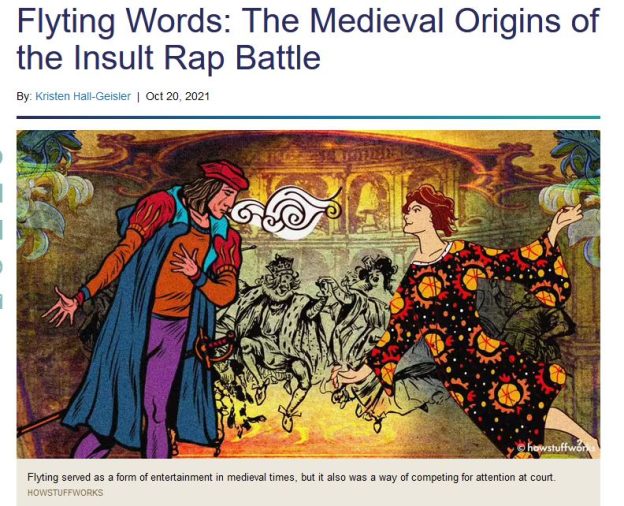
Now hold your horses, will you, because I also admire Christopher Hitchens as a stylist, conversationalist, and an extraordinary flyter. What is flyting, you ask? It’s an ancient Scottish form of invective, a true master of which is the MP George Galloway. I don’t care for his or Hitchens’ ever-shifting views, but I loved the flyting that flew between the two. Galloway called Hitchens a drink-sodden ex-Trotskyist popinjay. Hitchens responded over the pages of an august publication by likening the lickspittle praise Galloway once bestowed on him to spittle flung in place of argument. Later on, the two dueled deliciously on C-Span, where, I’m afraid, Hitchens proved his uncontested superiority in this spontaneous rhetorical art.

Twin Deceits: Shakespeare And Holocaust Denial

Anti-Semitism, Conspiracy, English, Literature, Pseudo-history

Shakespeare too has been the victim of the assault on history and truth. Assorted conspiracy kooks identify “the seventeenth Earl of Oxford, a courtier poet with some twenty fairly conventional lyrics to his name,” as the real deal. Writes Brian Vickers, in the August 19 & 26 issue of the Times Literary Supplement: “There are several insuperable objections to Oxford’s candidature: he died with a dozen of Shakespeare’s sole and co-authored plays unwritten (or at least unperformed); the style of his poetic oeuvre is extremely limited and un-Shakespearean; he led a busy and wasteful aristocratic existence abroad and at home.”

The Oxfordians, says Vickers, have performed all manner of chicanery to get around these difficulties, including to re-date plays and to “invent a new chronology, improbably dating Shakespeare’s early comedies to the late 1570s, and postulating that Oxford left drafts of all the remaining plays for Shakespeare to touch up and pass off as his own, either completely hoaxing everyone connected with the Globe [one of the theatres the busy Shakespeare managed—he worked daily with a host of theatre people], or relying on their connivance.”

“The Oxfordian cause has been vigorously pursued, with perverse enthusiasm…Supporters may sustain themselves with a sense of cocking a snook at official culture, or exposing an evil conspiracy whose existence was unsuspected for 300 years. But whatever the Oxfordians are producing, it is not scholarship.”

Scott McCrea’s The Case for Shakespeare: The End of the Authorship Question is “the latest in an honorable line of books reaffirming Shakespeare’s authorship, of which the most notable are H. N. Gibson’s The Shakespeare Claimants (1962), Samuel Schoenbaum’s Shakespeare’s Lives (1970; revised edition, 1991), Irving Matus’s Shakespeare in Fact (1994) and Jonathan Bate’s The Genius of Shakespeare (1997).” McCrea’s book is said to be of a high scholarly standard.

“In his final chapter, ‘All conspiracy theories are alike,’ [McCrea] suggests that ‘denial of Shakespeare follows exactly the same flawed reasoning as Holocaust denial’ in that it rejects the most obvious explanation of an event, and reinterprets evidence to fit a preconceived idea (‘the ovens at Auschwitz baked bread’).

[Curiously, when reporter Johann Hari went Undercover with the Holocaust Deniers,” he ran into our Shakespeare denier.]

Facts that contradict the theory are explained by conspiracy, but this ploy means that ‘conspiracy theories are really not theories at all,’ but faiths, which cannot be proved false. McCrea recognizes that, despite his subtitle, ‘there can never be an end to the Authorship Question,’ [ditto Holocaust denial], a depressing prospect.

He maintains a good-humored tone, a pleasant contrast to many works in this field, but one can be too cool. As we survey the never-ending flow of anti-Shakespeare books it is hard not to share the bitterness of Georg Brandes, moved in part to write his William Shakespeare (1898) by the ‘ignorant and arrogant attack’ of the ‘wretched group of dilettanti‘ who have ‘been bold enough… to deny William Shakespeare the right to his own life-work.'”

The Torah And The TLS

Critique, English, Hebrew Testament, Ilana Mercer, Judaism & Jews, Literature

Here’s a Letter-to-the-Editor of the British Times Literary Supplement. They wanted to publish it; I knew they would; Britons like a pedant. But they want private information about me, which I’m unwilling to disclose. What is it about so many private organizations these days that they act like government? On making a purchase, salesclerks will routinely ask for one’s address. Are they nuts? And most people comply. My husband takes cover whenever a salesperson dares to so pry.

Dear Editor,

In his review of Robert Alter’s The Five Books of Moses (TLS, June 24, 2005), John Barton praises the author’s translation of the Torah for “brilliantly imitating the Hebrew without sacrificing intelligibility.”
As someone who greatly admires the biblical narrator, I certainly agree that “welter and waste” does justice to “tohu vavohu” (Genesis 1:1), which Barton or the author transliterated to read “tohu wabohu.” Whence does that bowdlerization come? There’s no “wabohu” in Genesis 1:1—there’s no “wabohu” in the Hebrew language!
The first letter in vavohu is a “vav,” which is never a “w,” and here it’s pronounced “va.” The next Barton or Alter-bungled letter is an unpunctuated “Bet” (B), pronounced “v” too. Its enunciation here is “vo.” Hence, “vavohu.” I’m not sure how better to denote an unpunctuated “Bet” in English, but it’s certainly not a “b.”
So many scholarly writers, who profess to know Hebrew, habitually muck up the English transliteration of Hebrew words. Why?