Category Archives: Literature

George Orwell’s “1984” And The “Must Topple” List

America, Communism, Free Speech, History, Left-Liberalism And Progressivisim, Literature, States' Rights

FROM George Orwell’s “1984”: “Every record has been destroyed or falsified, every book has been rewritten, every picture has been repainted, every statue and street and building has been renamed, every date has been altered. And that process is continuing day-by-day and minute-by-minute. History has stopped. Nothing exists except an endless present in which the Party is always right.”

Must topple” is courtesy of the Observer-Reporter.

UPDATE (8/27/017): Rod Dreher’s Dreadful Writing At The American Conservative

Conservatism, English, Literature, States' Rights

How many first-person references can you count in this Rod Dreher bit of tedium? “I think.” “I believe.” “I’m not.” “Call me sentimental.” “My grandmother …”

Opinion differs about how often to use the first person pronoun in various genres of writing. But its overuse in opinion writing is a cardinal sin.

You may abuse “I” when the passive-form alternative is too clumsy. Or, when the writer has earned the right to, because of his relevance to the story. (There is no good reason for Dreher to insert himself in practically every other sentence here.)

To get a sense of how bad someone’s writing is count the number of times he deploys the Imperial “I” on the page. Dreher is very bad indeed. He is like a dripping tap. Half of this diarrhetic post could have been cut.

A good editor would have removed superfluous phrases like, “It’s strange, actually.” There are many like it: the aforementioned “call me sentimental” and “It seems to me.”

The American Conservative’s attitude to editing is decidedly un-conservative.

There are some redeeming observations in “Duty, Dishonor, & The South,” but they’re lost in the wishy-washy meandering narrative of a poor writer.

UPDATE (8/27): Noonan is bad (always has been), but not as awful as Dreher. She’s effective in her messy emotionalism. He’s not.

UPDATED (1/2/019): Meir Shalev: Easily One Of The Greatest Novelists

English, Human Accomplishment, Intelligence, Israel, Literature, Pop-Culture

I’ve been reading two classic novels by Meir Shalev in Hebrew, in the hope of reviving my extant Hebrew reading skills.

The one completed some time ago was Roman Rusi (“A Russian Novel,” translated), which was changed to The Blue Mountain. A lot hangs on the translation, naturally, but having read “Roman Rusi” (aka “The Blue Mountain“) both in English and Hebrew, I can say Hillel Halkin’s translation of that book was superb.

Shalev, for the richness of his descriptions and the depth of the depictions and characters (down to the animals), is up there with the greatest writers. Nabokov of the Israelis? Maybe, but Shalev doesn’t have Nabokov’s prurient preoccupied with decadence.

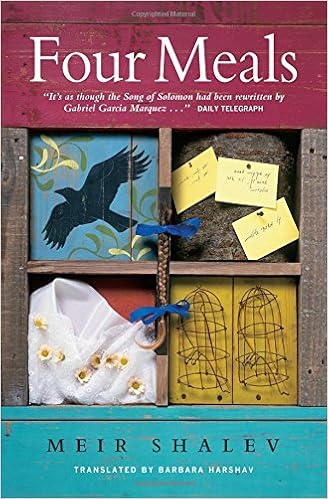
Even finer than “The Blue Mountain” is “As A Few Days,” which is currently tearing at my heart. Read it (and my non-fiction books, of course). It also goes by the title “Four Meals” or “The Loves of Judith.”

UPDATED (1/2/019):

Amos Oz was not a good writer, Tom Segev. He had nothing on Agnon, of whom he was madly jealous, or on Meir Shalev, a literary giant. I recently completed Oz’ latest door-stopper in Hebrew: undisciplined, cumbersome, narcissistic. Absolutely no literary finesse.

MORE.

UPDATED (7/10): Solzhenitsyn On The West’s ‘Persisting Blindness Of Superiority’ (American Exceptionalism)

Left-Liberalism And Progressivisim, Literature, Neoconservatism, Political Philosophy, Russia, The West

“But the persisting blindness of superiority continues to hold the belief that all the vast regions of our planet should develop and mature to the level of contemporary Western systems, the best in theory and the most attractive in practice; that all those other worlds are but temporarily prevented (by wicked leaders or by severe crises or by their own barbarity and incomprehension) from pursuing Western pluralistic democracy and adopting the Western way of life. Countries are judged on the merit of their progress in that direction. But in fact such a conception is a fruit of Western incomprehension of the essence of other worlds, a result of mistakenly measuring them all with a Western yardstick. The real picture of our planet’s development bears little resemblance to all this.”

In other words, American Exceptionalism. The West Doesn’t understand ‘other worlds.’

“A World Split Apart — Commencement Address Delivered At Harvard University, June 8, 1978.”

Disillusioned with the West, Solzhenitsyn returned to Russia, “leaving behind [what he perceived as a] dying civilization fatefully wedded to a democratic ideology.” In time, neocons and liberals rejected the great man, going on to adopt, instead, regime-changing, neocon, Russian dissidents.

… The West’s freedom, Solzhenitsyn declared … had degenerated into license, its media filled minds and souls with gossip and nonsense, its popular culture served only to coarsen and degrade, its people exhibited an unthinking sympathy for socialism and an inability to recognize evil.
… Overnight, those who had lionized Solzhenitsyn cast him into the outer darkness and adopted in his place the nuclear physicist and Western-oriented dissident Andrei Sakharov. A good and courageous man, Sakharov was a secularist and self-proclaimed socialist who had mastered the language—“democracy” and “human rights”—of Western liberalism. …
…Solzhenitsyn was [accused of being] a Russian nationalist and imperialist. In fact the great writer was a patriot who loved his country and expected others to love theirs; he explicitly repudiated nationalism and imperialism. More important, Mahoney recognizes that ‘a burning love for one’s motherland [is] compatible with humility before God and deference to a universal moral order.’

MORE. “Solzhenitsyn Wasn’t Western.”

UPDATE (7/10): FACEBOOK DEBATE IS HERE.

Comments Off on UPDATED (7/10): Solzhenitsyn On The West’s ‘Persisting Blindness Of Superiority’ (American Exceptionalism)