Category Archives: Morality

Precious Oscar-Wood Pacifies Himself

Environmentalism & Animal Rights, Ethics, Family, Ilana Mercer, Morality, Parrots, Relatives

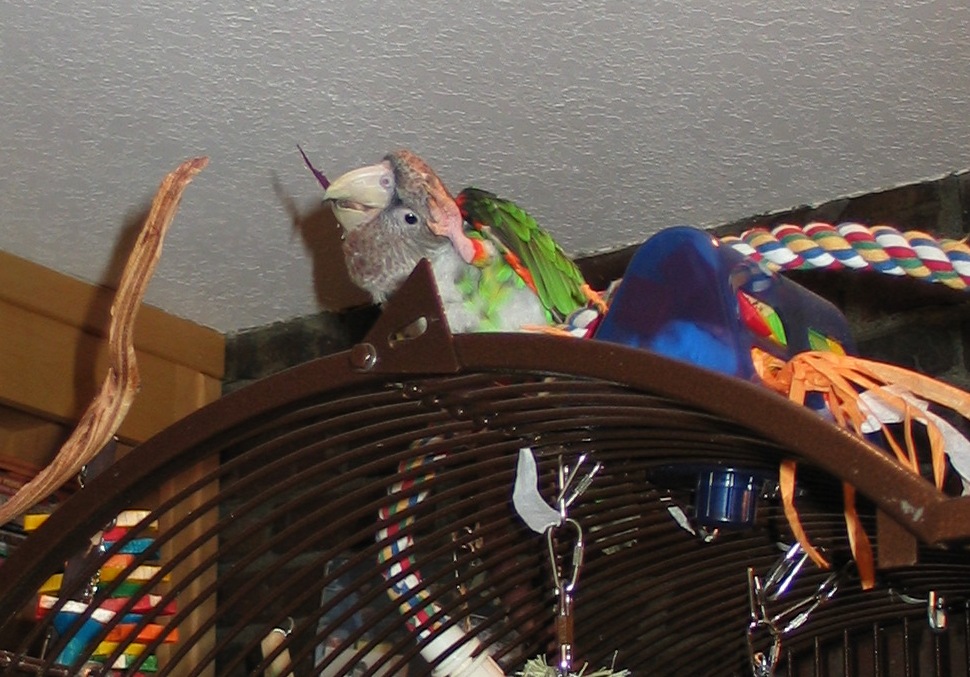
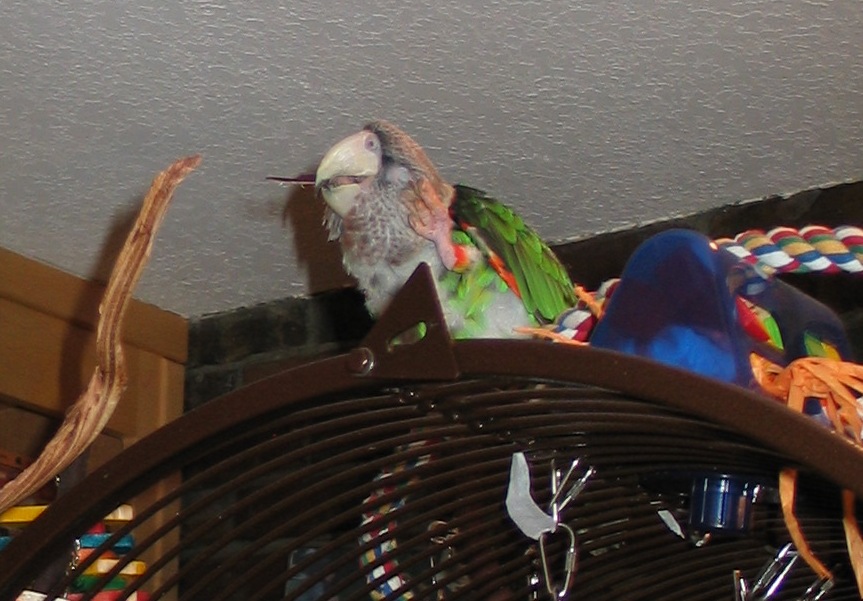
Does it get more adorable than this little parrot? Like a baby would, Oscar-Wood, my Un-Cape parrot (Poicephalus fuscicollis), pacifies himself. An infant will suck on a finger or a pacifier (dummy in British English). Oscar-Wood sucks on a bit of wood he breaks off, and tickles his head and neck with pink, dexterous, hand-like claws, at the same time. He will fold one magical toe over the other three to create an ideal tickling implement. (Click on images to enlarge.)

I’ve tried to Google about the remarkable claw-eye-beak (“fine motor”?) coordination displayed by the parrot (watch this genius macaw), but can’t find much. (Help? Here is The Smart Bird Page, more anecdotal and amusing than scientific.) When I first became a parront, I was unaware of the remarkable claw- structure and dexterity the parrot possesses. Unlike most ordinary birds who have one back- and three front claws , the parrot has two in front and two at the back. These he cups when he eats, as the parrot will delicately hold a piece of food in his claw and pick at it with his beak. The parrot will also use these delicate appendages to manipulate objects. For example, Oscar-Wood stabilizes this barrel-of-fun with his pink claws, and then uses his mother-of-pearl beak to twist the thing in the right direction and then pull the barrel to pry a nut from within.

The human being’s fantastic facility with his digits is one indication of his great intelligence. In addition to their hand-like structure, the parrot’s claws, similarly, are huge in proportion to his little body—approximately a fifth of the size of his body when stretched out. This relationship is surely mirrored in the area given over in the parrot’s brain to the claws.

As I’ve reported here before, there has been good, if not sufficient, research into the great intelligence of the parrot, especially of the African Grey (who easily trumps the primates). But I have not seen specifics about the adroit claws that so fascinate me.

So too are the language-acquisition skills of the parrot remarkable. Human beings have often, conveniently, explained the parrot’s speech as pure mimicry. Just as a child would, however, the parrot absorbs the language he is capable of acquiring through imitation, behavioral conditioning, reinforcement, all in context. As is the case with toddlers, the orphaned parrot (who has been in a shop or shelter for too long) will have often missed the crucial, optimal period during which language is learned. I find that Oscar-Wood, who spent the first 4 years of life in a shop, caged, mostly, has fewer language skills than little T. Cup, who arrived in our home as a 7 month old baby. T. Cup uses words in context. If I’m out of the room, he’ll call, “Mommy, mommy.” He has just learned the great benefits that come with demands for “Daddy, daddy.”

As I type, he is muttering to himself (after causing a racket by bashing his water bowel): “Stop it, stop it.” Around food time, it’s “Yummy-yummy.” When caged, he’ll emit cries of “Outside, outside.” Should T. Cup become very noisy, Oscar-Wood will scold him in his cute little voice: “Step-up, step-up,” which is the command parronts give their parrots to step-up onto them.

Humans love to watch Disneyfied, talking dogs, pigs, spiders—all animals that DON’T TALK, and have very few human attributes. Indeed, the parrot is the most proper object of Anthropomorphism.

However—and I know I’ll anger the wonderful woman bird-breeder who sold us these two characters—I don’t think parrots are suitable pets for most people. They are far too labor-intense, needy, sensitive and sentient. A constantly caged, lonely, unattended parrot will immediately become a “problem bird” (the owner being the real problem), who will soon be the object of abuse.

I am oh-so-very fortunate to work from home. Thus, my parrots are seldom caged; talk to me constantly, and have a flock-like arrangement with us. Cage these social creatures and deny them the one-on-one bond formation their biological blue-print dictates—and you have a tragic, depressed, feather-denuded little bird.

Think about it: Many parrots pair for life, create creches in which they raise their young; and when a Hyacinth Macaw, for example, loses a partner, the widow/widower is then adopted by an intact pair. This rather advanced social life precludes adaptation to a lonely, caged existence.

UPDATED: The Founding Fathers Deconstructed (MT, Saint Or Sadist?)

Africa, America, Christianity, Colonialism, Founding Fathers, History, Intelligence, Morality, Propaganda

From today’s WND.COM column, “The Founding Fathers deconstructed”:

“The idea that the founders were flawed, sinful men like you and me is current among a hefty majority of Americans, conservative too. It is wrong. Quite the reverse. The founders were nothing like us. Not even close. I say this not as an idealist but as a realist.

” … Judging from their works and their written words, the American Founding Fathers were immeasurably better than just about anyone on earth today. That goes for that gnarled, somewhat stupid sadist Mother Teresa, whom Christopher Hitchens nailed in The Missionary Position: Mother Teresa in Theory and Practice. And it applies to the moral role models selected for us annually, courtesy of CNN’s Anderson Cooper.

The founders are matchless today both morally and intellectually – their actions bespeak a willingness to forsake fortunes and risk lives for liberty, a concept and cause alien to contemporary Americans, who are, mostly, bereft of both the mental and moral gravitas necessary to grasp it. … ”

The complete column is: “The Founding Fathers deconstructed.”

The Second Edition of Broad Sides: One Woman’s Clash With A Corrupt Society (the print edition can be purchased here) is now also available on Kindle.

UPDATE (Dec. 3): MT, SAINT OF SADIST? Just as I thought I had written an uncontroversial column, Rod writes to write me off as a writer, a human being, etc.:

He quotes my column: Judging from their works and their written words, the American Founding Fathers were immeasurably better than just about anyone on earth today. That goes for that gnarled, somewhat stupid sadist Mother Teresa, whom Christopher Hitchens nailed in ‘The Missionary Position: Mother Teresa in Theory and Practice.'”

First sentence quite good – second one horribly bad. Are you an atheist like Hitchens? Why would you appeal to such a God-hater as any kind of authority on the likes of Mother Teresa. And I wouldn’t think you should need reminding, but Mother Teresa is now outside the scope of your “… immeasurably better than just about anyone on earth today” – since she died 3 years ago. I can’t argue you observation of “gnarled”, or even “somewhat stupid” – but “sadist”; do you get that from Hitchens, or is this you own “somewhat stupid” idea. You had my rapt attention, and your article was making great sense – until you brought in Mother Teresa, out of the blue, I mean the “wild blue, way up yonder” out of the blue. …
I’ve been reading you for years on WND, and must say you are an excellent writer, and appear to have a brilliant mind. But you really lost it with this one. Hitchens book title is bad enough, then you pile on further insult with your “Hitchens nailed [her]” comment – are you trying to be more vulgar and disgusting that the somewhat stupid atheist, or are you just being stupid yourself.
One last thing – beauty is (truly) only skin deep. Yet you include your picture in the article – I suppose so we can all see how ‘beautiful’ you are on the outside. But in God’s economy, I daresay Mother Teresa is far more beautiful – one of the most beautiful in my lifetime. Her beauty radiates from within, just as your ugly heart is coming to the light through your vulgar words.
I guess you’ve concluded by now that you’ve lost a long-time fan.

Mother Teresa is held up as a universal paragon of goodness in it purest form. Hence the reference to her in the column. As someone who prefers facts to blind faith, indeed I do think Hitchesn—who hung out in Calcutta with Mother, and did his homework well—nailed this sister’s act (as in “detect and expose”).

More later (the parrots are demanding birdie bread with calls of “mommy, mommy”).

Later: If I am supposed to discard the facts because they were dredged up by an atheist (CH), I suggest that my reader question his adulation for a woman (MT) worshiped by former White House communications director Anita Dunn.

“My favorite political philosophers: Mao Tse-tung and Mother Theresa,” said the lizard-tongued Dunn.

I am absolutely sure that I share no heroes with Dunn. Picture a Venn diagram. There is no overlap between my mental/intellectual universe and Dunn’s.

The facts, as illustrated by Hitchen, show that MT preferred “providence to planning” in her facilities and was far from humane to the poor she took in. Hitchen quotes, among others, a doctor, the editor of the acclaimed “Lancet,” who was alarmed at the intentional neglect of proper diagnosis and pain management at a MT operation. On Mother’s orders, lavish, well-appointed homes that were donated to her cause were stripped bare of decent mattresses or creature comforts. The heat turned off. Volunteers got TB.

As a matter of theology, MT insisted that the poor be left to suffer horrible pain (while she was always airlifted to receive medical care in the best western facilities). Salvation through suffering for the poor, but not for Mother. Hypocrite?

MT, moreover, had a sizable fortune, enough money to outfit many clinics in Bengal (or wherever she operated). But she pursued “suffering and subjection” for her charges and for those working for her. If a dying man got an aspirin from her, he was lucky. Her palliative philosophy was in direct opposition to that of the Hospice movement.

Unforgivable. “Hell’s Angel.”

Myron, Mother T. had close ties to a lot of very corrupt governments, so she was hardly the epitome of private charity. Her motto seemed to have been: “money has no smell.”

“Libertarians On The Shrink’s Couch”

Intellectualism, Intelligence, libertarianism, Morality, Objectivism, Reason

“A team of social psychologists,” reports Gene Healy, “including the University of Virginia’s Jonathan Haidt, provides some of the most detailed answers yet, putting libertarians on the couch in a new study, ‘Understanding Libertarian Morality.'”

“For several years now, at YourMorals.org, they’ve let self-described liberals, conservatives, and libertarians speak for themselves, by voluntarily taking a battery of psychological tests measuring personality characteristics, cognitive style, and moral values. Along the way, they’ve compiled the ‘largest dataset of psychological measures ever compiled on libertarians’ — with more than 10,000 respondents.”

“Libertarians tend to be dispassionate and cerebral, less likely to moralize based on gut reactions like disgust (one source, the authors suggest, of our disagreement with conservatives on social issues).

“‘We found strong support,’ they write, for the proposition that libertarians ‘will rely upon reason more — and emotion less — than will either liberals or conservatives.’ Blubbery Clintonian empathy isn’t our bag, baby; we don’t ‘feel your pain.’ Where ‘liberals have the most ‘feminine’ cognitive style … libertarians have the most ‘masculine.’ And where others often ‘rely on peripheral cues, such as how attractive or credible a speaker is,’ when formulating opinions, libertarians are more likely to pay ‘close attention to relevant arguments.'”

[SNIP]

I prefer to put it a little differently, as I did in an interview with Everyman: A Men’s Journal:

“When people are rational, they observe reality as it is, and are more likely to be concerned with justice and avoid misplacing compassion. So the starting point is, unavoidably, a return to reason. … I certainly understand your concern and agree with you that the arguments we’ve made in favor of justice for men are less intuitive and less visceral than the arguments feminists make. But since we know our more complex arguments are the right ones, we have the answer: to make people fairer, kinder, and more compassionate, one has to first make them able to think and reason. In the introduction to F.A. Hayek’s The Road to Serfdom, economist Milton Friedman underscores this point: ‘The argument for collectivism is simple if false; it is an immediate emotional argument. The argument for individualism is subtle and sophisticated; it is an indirect rational argument.”

“Sure, making people just isn’t easy. But it certainly won’t work if you aim for the gut instead of the gray matter. As usual, Oscar Wilde said it best in one of his plays: ‘She thought that because he was stupid he would be kindly, when of course, kindliness requires imagination and intellect.'”

"Libertarians On The Shrink's Couch"

Intellectualism, Intelligence, libertarianism, Morality, Objectivism, Reason

“A team of social psychologists,” reports Gene Healy, “including the University of Virginia’s Jonathan Haidt, provides some of the most detailed answers yet, putting libertarians on the couch in a new study, ‘Understanding Libertarian Morality.'”

“For several years now, at YourMorals.org, they’ve let self-described liberals, conservatives, and libertarians speak for themselves, by voluntarily taking a battery of psychological tests measuring personality characteristics, cognitive style, and moral values. Along the way, they’ve compiled the ‘largest dataset of psychological measures ever compiled on libertarians’ — with more than 10,000 respondents.”

“Libertarians tend to be dispassionate and cerebral, less likely to moralize based on gut reactions like disgust (one source, the authors suggest, of our disagreement with conservatives on social issues).

“‘We found strong support,’ they write, for the proposition that libertarians ‘will rely upon reason more — and emotion less — than will either liberals or conservatives.’ Blubbery Clintonian empathy isn’t our bag, baby; we don’t ‘feel your pain.’ Where ‘liberals have the most ‘feminine’ cognitive style … libertarians have the most ‘masculine.’ And where others often ‘rely on peripheral cues, such as how attractive or credible a speaker is,’ when formulating opinions, libertarians are more likely to pay ‘close attention to relevant arguments.'”

[SNIP]

I prefer to put it a little differently, as I did in an interview with Everyman: A Men’s Journal:

“When people are rational, they observe reality as it is, and are more likely to be concerned with justice and avoid misplacing compassion. So the starting point is, unavoidably, a return to reason. … I certainly understand your concern and agree with you that the arguments we’ve made in favor of justice for men are less intuitive and less visceral than the arguments feminists make. But since we know our more complex arguments are the right ones, we have the answer: to make people fairer, kinder, and more compassionate, one has to first make them able to think and reason. In the introduction to F.A. Hayek’s The Road to Serfdom, economist Milton Friedman underscores this point: ‘The argument for collectivism is simple if false; it is an immediate emotional argument. The argument for individualism is subtle and sophisticated; it is an indirect rational argument.”

“Sure, making people just isn’t easy. But it certainly won’t work if you aim for the gut instead of the gray matter. As usual, Oscar Wilde said it best in one of his plays: ‘She thought that because he was stupid he would be kindly, when of course, kindliness requires imagination and intellect.'”