Category Archives: Iraq

The Worst of Times

Bush, Economy, Foreign Policy, Iraq, Jihad, Liberty, Military, Nationhood, Neoconservatism, Terrorism, War

National Journal has had an aha Moment: “The 10 years since the terrorism attacks of 9/11 rank among America’s most troubled,” concludes the Journal’s Ronald Brownstein:

[George W. Bush’s] “mismanaged wars in Afghanistan and Iraq sapped U.S. strength and imposed costs vastly exceeding their benefits. Overstretched and in the red, America ends the decade weaker on many international dimensions than when it began… At home,… the median income is now lower than in 2001 and the number of Americans in poverty nearly one-third higher. Most incredibly, fewer Americans are working today than in September 2001—a decadelong record of decline matched since 1900 only during the 1930s. Faith in all public and private leadership is flickering.”

No doubt, it began with Bush, who was bad to the bone.

UPDATE II: Media’s Sickening Sentimentality On Egypt

Conspiracy, Government, Iraq, Journalism, Left-Liberalism And Progressivisim, Media, Middle East, Reason

The following is an excerpt from my new WND.COM column, “Media’s Sickening Sentimentality On Egypt”:

“… I’ve finally figured out what it was that repulsed me so about American opinion-makers’ slobbering response to [the revolt that began in Cairo’s Tahrir Square, and swept the Egyptian president, Mohammed Hosni Mubarak, from office.]

It was not so much that the media ignored the likely possibility that democracy in a country that has become progressively more Islamic since the 1950s might not have a happy ending.

It was not that the media pretended that the Muslim Brotherhood, also the “best organized opposition force in the country,” would not field a viable presidential candidate.

It was not that, in their jubilation, Anderson Cooper (CNN), Neil Cavuto (Fox News) and Christiane Amanpour (ABC) failed to mention the precedent set in Lebanon, where Hezbollah has deployed the democratic process to get the better of the country’s Maronite Christians.

It was not even the fact that the journalistic imperative to provide nuance, detail, and an economic and historic backdrop to the unfolding events was replaced, by the journalistic jet-set, with the telegenic drama of the man on the street.

None of this bothered me as much as the patronizing position these American reporters adopted; the neat bifurcation they managed to maintain between “Us” (the “free” men and women of America) and “Them” (those pathetic, shackled Egyptians).

The fact is that the heroic movement for democracy in Egypt dovetails with an ongoing flirtation with fascism in the U.S.; the twilight of individual sovereignty in the U.S. contrasts with its rise in Egypt. …

Read the complete column, “Media’s Sickening Sentimentality On Egypt,” now on WND.COM.

UPDATE I (Feb. 18): To the letter writer below: I am not a conspiracy theorist. Here is a post that explains why conspiracy is usually irrational.

“The premise for imputing conspiracies to garden variety government evils is this: government generally does what is good for us (NOT), so when it strays, we must look beyond the facts—for something far more sinister, as if government’s natural venality and quest for power were not enough to explain events. For example, why would one need to search for the “real reason” for an unjust, unscrupulous war, unless one believed government would never prosecute an unjust war. History belies that delusion.” …

UPDATE II (Feb 19): Daine: No; there are no conspiratorial. What we have are The Takers-–tax consumers—who want the Makers—the so-called rich—to support their parasitical life style. And the Über-parasites, the politicians, who make the most of this human nature.

Assassinations Under US Auspices?

Constitution, Criminal Injustice, Foreign Policy, Intelligence, Iraq, Journalism, Justice, Law, Media, Middle East

I hope the failed assassination attempt on Omar Suleiman, Egypt’s vice president, recently appointed to quell the unrest in that country, is not a harbinger of things to come. I am thinking of the vulgar cellphone images that circulated the Internet, in which a stoic Saddam Hussein, noose about his neck, is heckled by a hooded Shiite executioner. Even more repugnant than the hasty hanging carried out under US auspices were the US-sponsored legal proceedings that preceded it. (All the obligatory denunciations of Hussein obtain here, naturally. Bad man. Bad man. Bad man.) That Tribunal, which was branded “made-in-America,” had more in common with the French Revolutionary Assembly (See “No Due Process For A Despot”).

Similarly, such a barbaric specter in Egypt (conjuring the French, and not the American, Revolution), will have been greatly inspired, like in Iraq, by American media screeches.

I worry because the US is not necessarily averse to hasty hangings, considering that the strongmen we betray may turn around and tell all: You know; the stuff about how they helped the U.S. with its rendition and torture programs.

"The 'Lebanonisation' of Iraq"

Foreign Policy, Iraq, Journalism, Propaganda, War

“With a sectarian power-sharing agreement and interfering neighbours, Iraq is looking a lot like Lebanon,” writes Lamis Andoni at Al Jazeera.

Where else? Now that the Left is as invested in all Obama’s wars as the “Right,” sober assessment of regions made more backward and benighted for our interventions is hard to come by in American media. There is nothing new about the silence of collaborators in this country, Left and Right.

ANDONI AGAIN:

“The power-sharing framework agreed in Iraq has so far failed to end the eight month deadlock over the structure of a new cabinet. The stalemate, due to haggling over key posts, is reflective of how post-invasion Iraq has succumbed to ethnic and sectarian rivalry, which, in turn, has further obstructed its economic and political recovery. It is also indicative of how the country has become a playground for different regional and international powers who are competing for influence and the country’s oil resources.”

The agreement reached earlier this month would allow Nuri al-Maliki, the incumbent prime minister, to form a new government – even though the Iraqiya coalition took two more seats than his State of Law alliance in the parliamentary elections.

The accord would establish a Lebanon-style sectarian and ethnic formula – which might prove to be more of a recipe for constant instability than a guarantor of national reconciliation. It is ironic that we are witnessing the ‘Lebanonisation’ of Iraq at the exact moment when this type of power-sharing formula may be causing the ‘Iraqisation’ of Lebanon – as many fear that Lebanon is on the verge of inter-sectarian strife. …

Iraq’s emerging political system is a direct product of the US invasion and Iran’s complicity in both the invasion and the ensuing occupation. And Iran has, so far, come out of it with the strongest hand – as the prime minister is the main authoritative power. Neighbouring ‘Sunni’ Arab countries have also played a role in consolidating divisions within Iraq – either by directly helping the US forces or by failing to help Iraq maintain its unity.”

[SNIP]

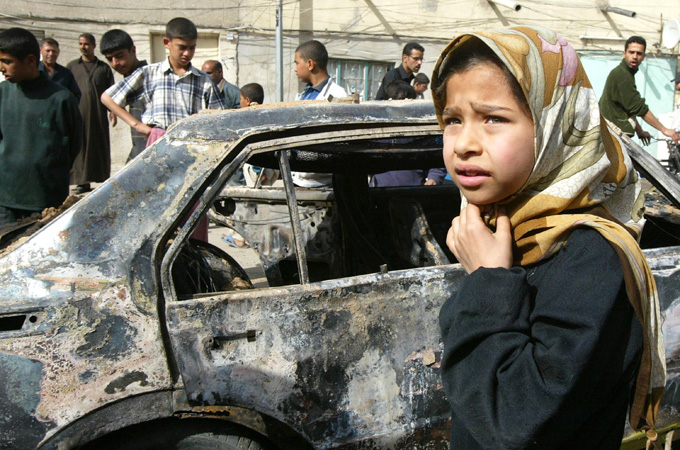
Where there was once oppression and order, now there is just chaos and daily danger. What always gets me is the terror on the faces of children trying to survive in “liberated” Iraq.