Category Archives: Technology

What Canada’s Outbreak Scientists Knew About WuFlu By December 31 (And The US Was Too Callous and Incurious To Find Out)

Canada, China, COVID-19, Intelligence, Technology

It’s telling that, not the US, but a Canadian company, Blue Dot, was among the first to raise the alarm about WuFlu in late December. It uses an Artificial Intelligence algorithm, which pointed to the suspect wetmarket, then lit up as the infection spread therefrom. Anybody could have purchased this program.

The company, Blue Dot, had no clients in the [intellectually incurious?] U.S.

Come to think of it, the US’s formidable Surveillance State should have known about Blue Dot technology, but I guess the program doesn’t appear to harvest personal data, only anonymized data, thus holding no appeal to the opportunistic overlords referred to reverentially as “the U.S. intelligence community.”

Neither does the Blue Dot computer rely on official statements from state actors in tracking an outbreak. It seems to be a mighty analyst and information aggregator. Thus, by the dates mentioned, “Their algorithm was already churning through data, including medical bulletins, even livestock reports, to predict where the virus would go next.’

Canada should certainly have even fewer deaths from coronvirus given that one of its companies had some of this most sophisticated, foolproof methods to track a pandemic before it hits (Canada likely chose not to stop flights from China, even though it knew the score well before our covidiots):


When you’re fighting a pandemic, almost nothing matters more than speed. A little-known band of doctors and hi-tech wizards say they were able to find the vital speed needed to attack the coronavirus: the computing power of artificial intelligence. They call their new weapon “outbreak science.” It could change the way we fight another contagion. Already it has led to calls for an overhaul of how the federal government does things. But first, we’ll take you inside BlueDot, a small Canadian company with an algorithm that scours the world for outbreaks of infectious disease. It’s a digital early warning system, and it was among the first to raise alarms about this lethal outbreak.

It was New Year’s Eve when BlueDot’s computer spat out an alert: a Chinese business paper had just reported 27 cases of a mysterious flu-like disease in Wuhan, a city of 11 million. The signs were ominous. Seven people were already in hospitals.

Almost all the cases came from the city’s sprawling market, where live animals are packed in cages and slaughtered on-site. Medical detectives are now investigating if this is where the epidemic began, when the virus made the leap from animals to us.

… Chinese officials were secretive about what was happening. But BlueDot’s computer doesn’t rely on official statements. Their algorithm was already churning through data, including medical bulletins, even livestock reports, to predict where the virus would go next.

It was also scanning the ticket data from 4,000 airports.

BlueDot wasn’t just tracking flights, but calculating the cities at greatest risk. On December 31, there were more than 800,000 travellers leaving Wuhan, some likely carrying the disease.

In a matter of a just seconds, the Blue Dot computer can “analyze and visualize all this information across the globe in just a few seconds.”

“The virus wasn’t just spreading to east Asia. Thousands of travelers were heading to the United States too. … Most of the travel came into California and San Francisco and Los Angeles. Uh, also, into New York City. And we analyzed that way back on December 31. Our surveillance system that picked up the outbreak of Wuhan automatically talks to the system that is looking at how travelers might go to various airports around Wuhan.”

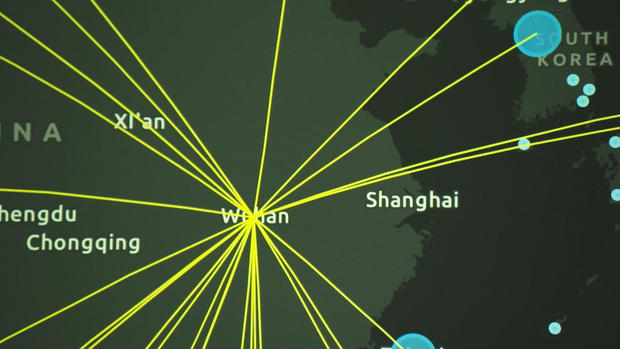
The virus spread across Asia with a vengeance. BlueDot has licensed access to the anonymized location data from millions of cellphones. And with that data it identified 12 of the 20 cities that would suffer first.

Dr. Kamran Khan: What we’re looking at here are mobile devices that were in Wuhan in the previous 14 days and where are they now across East Asia. Places like Tokyo have a lot of devices, Seoul in South Korea–

Bill Whitaker: So you’re following those devices from Wuhan to these other cities?

Dr. Kamran Khan: That’s correct. I do wanna point out these are also anonymized data. But they allow us to understand population movements. That is how we can understand how this virus will spread.

To build their algorithm, Dr. Khan told us he deliberately hired an eclectic mix: engineers, ecologists, geographers, veterinarians all under one roof. They spent a year teaching the computer to detect 150 deadly pathogens.

Dr. Kamran Khan: We can ultimately train a machine to be reading through all the text and picking out components that this is talking about an outbreak of anthrax and this is talking about the heavy metal band Anthrax. And as you do this thousands and thousands and thousands of times, the machine starts to get smarter and smarter.

Bill Whitaker: And how many different languages does the computer understand?

Dr. Kamran Khan: So it’s reading this currently in 65 languages, and processing this information every 15 minutes, 24 hours a day. So it’s a lotta data to go through.

Within two hours of detecting the outbreak on December 31, BlueDot had sent a warning of the potential threat to its clients: public health officials in 12 countries, airlines and frontline hospitals, like Humber River in Toronto.

The US was too dumb and callous to buy Blue Dot’s AI program.

MORE: “The computer algorithm that was among the first to detect the coronavirus outbreak.”

Comments Off on What Canada’s Outbreak Scientists Knew About WuFlu By December 31 (And The US Was Too Callous and Incurious To Find Out)

Sewage In Seattle

Environmentalism & Animal Rights, IMMIGRATION, Left-Liberalism And Progressivisim, Technology

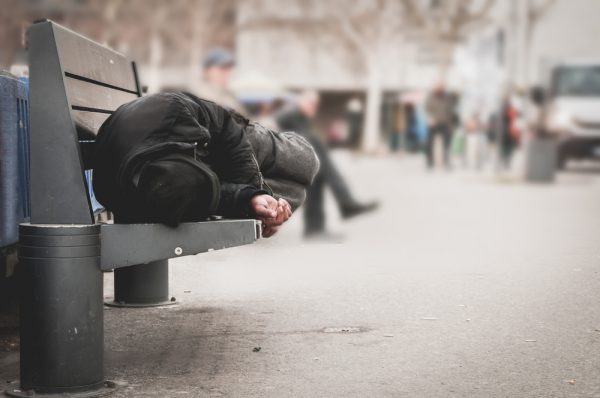
As argued in “Homeless In Seattle, Part 2: Tech Sucks The Soul Out Of The City” & “Homeless In Seattle, Part 1: High-Tech Harm The Homeless,” homelessness and extreme poverty in Seattle and beyond are helped along by Big-Tech’s non-stop importation of a feudal elite.

Homelessness and extreme poverty, enabled by the agents forenamed, also increase pollution:

In addition to the homeless who are living in tents on the sidewalk, Seattle is also dealing with an increasing number of people who are living in RVs. Because these people have no homes, they have nowhere to properly dump the sewage that accumulates in their vehicles. Instead, the waste gets dumped directly into storm drains that connect to waterways. Two business groups in the city have funded testing related to the dumping and reached some stunning results

Does the Left care? Of course not.

Seattle’s RV campers dump an estimated 1 million gallons of raw sewage into waterways per year.”

UPDATED (10/22/019): Homeless In Seattle, Part 2: Tech Sucks The Soul Out Of The City

Business, IMMIGRATION, Labor, Regulation, Technology

NEW COLUMN IS “Homeless In Seattle, Part 2: Tech Sucks The Soul Out Of The City.” It’s on Townhall.com, WND.COM and The Unz Review.

An excerpt:

Trust the late Anthony Bourdain, the Kerouac of cooking, to blurt out the truth when nobody else would.

Following his Jack Kerouac wanderlust, Bourdain had arrived in Seattle to spotlight the manner in which high-tech was changing the city, draining it of its character and of the many quirky characters that made Seattle what it was

“Microsoft, Google, Twitter, Expedia, and Amazon are the big dogs in town,” mused  Bourdain. “A flood of them—tech industry workers, mostly male, derisively referred to as tech boys or tech bros—is rapidly changing the DNA of the city, rewiring it to satisfy their own newly-empowered nerdly appetites.”

That the “tech boys” “are so dull,” as members of a Seattle band say—and sing—in no way assuages their heated effect on the housing market. A street artist called “John Criscitello … told Bourdain how the high-tech influx has driven up housing costs and forced artists [like himself] out of the neighborhood.”

Yes, Big Tech is exacerbating homelessness in Seattle and the surrounds. While correlation is not causation, the ongoing and never-ending, annual importation of a sizable feudal elite from China and India must be factored in the homelessness equation.

“Buoyed by the city’s thriving technology industry, Seattle has consistently been the hottest housing market in the nation.” Commensurate with the explosion in the number of Seattle neighborhoods in which homes cost $1 million has been an explosion in the region’s homeless population.

“Households must earn about $140,000 a year to afford mortgage payments – nearly double the city’s typical income,” but on par with the “average base pay” of a software engineer in the Seattle, WA area. …

…   “Unabashed liberal” outfits like the Economist, the Brooking Institute and the Seattle Times blame inadequate supply for the housing crisis, ignoring the demand side of the supply-and-demand housing equation whereby, “Big Tech is permitted to petition The State for permission to import The World at a price heavily subsidized by the disenfranchised American taxpayer. Through government immigration policies, a ceaseless demand for housing has been generated.”  (See “Homeless In Seattle, Part 1.”) ….

… READ ON. NEW COLUMN, “Homeless In Seattle, Part 2: Tech Sucks The Soul Out Of The City,” is on Townhall.com, WND.COM and The Unz Review.

* Image courtesy of The Unz Review.

UPDATED (10/22/019):

Indian Graduates Green-Lighted To Take Middle-Class Jobs From American Graduates

IMMIGRATION, Labor, Outsourcing, Republicans, Technology

Sen. Mike Lee (R-UT) has always been a slithering political snake of the worse kind.

In the Washington Examiner, the sanctimonious Lee writes that, “People are always our greatest resource and should be our first priority. It’s social capital, embedded in our relationships, that can provide the best meaning, care, and support in people’s lives, at every stage of life. …”

Then he turns around, and, joined by Sen. David Perdue (R-GA), authors a Bill that’ll

allow investors and their companies to reward many more Indian graduates who agree to take the college graduate jobs needed by young American graduates. The reward is the grant of 120,000 invaluable green cards — up from roughly 20,000 today — to the Indian outsourcing workers and their families.

The so-called “Fairness for High Skilled Immigrants Act” [every outlet reports a different Bill title] will be

a huge economic hit to the roughly 800,000 Americans who are graduating in 2019 with degrees in health care, science, engineering, accounting, business, software, math, or architecture.

Also Via Breitbart:

The giveaway is in a House bill, HR.1044, and a matching Senate bill, S.368. Both bills end the country caps, provide fast-track green cards to roughly 300,000 Indian H-1B contract workers, and both expand the reward for more Indians to become contract workers in the United States — and neither bill offers any significant benefits to Trump’s agenda or Americans.

The liars in Congress give their Bill an Orwellian name: “Bill to Strengthen American Workforce, Reduce Visa Backlog for High-Skilled Immigrants.

The Daily Caller calls the disenfranchising of American graduates a “big revamp”:

The proposed legislation has the chance to be the biggest revamp of America’s immigration system since the 1965 Immigration and Nationality Act, but is getting little if any attention from the press due to the impeachment drama currently unfolding on Capitol Hill.

* Image courtesy of ID 29261524 © Ivelinr| Dreamstime.com