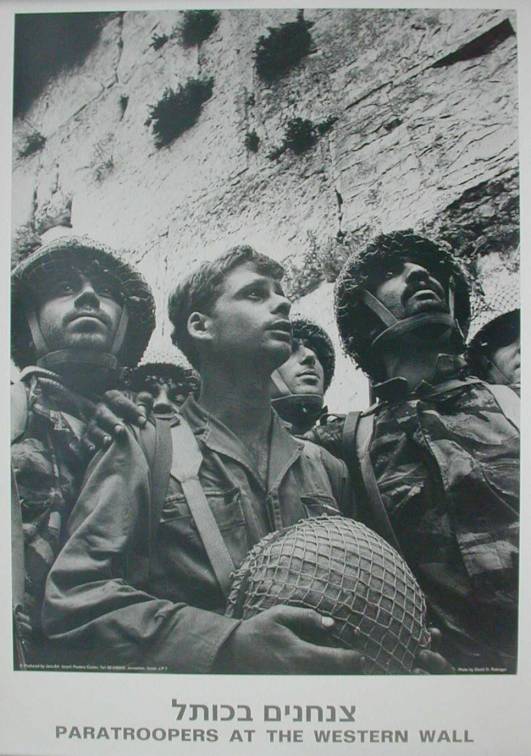
THE FOLLOWING EVOCATIVE PIECE was written by a special young woman, my daughter. She traveled to Israel with the common political perspective, imbibed in insulated, privileged, propagandized North America—and shared by left-liberals and paleos alike. Once in Israel, she underwent a transformative experience.
Most individuals who write about Israel, pro and con, should not be doing so, as they have never experienced the place or the people. I’m proud of my girl. Aside a talent for spare, strong writing, she had the heart and the head to rethink received ideology when confronted by something far more powerful and persuasive.
Impressions From Jerusalem
By Nicky
My idea of a militarized society was that of the USA. Soldiers and armed guards are visible only where security is needed. They are stern, unsmiling, erect. They signify danger and command respect, wordlessly and humorlessly.
In Canada, my only experience of the military is the odd soldier in fatigues on the street, perhaps on the bus: an object of casual consideration. I view him with the privileged gaze of a Western pacifist, not obliged to look him in the eye. I think: “Why, friend, what are you doing in that uniform? What are you afraid of? What did the government tell you to make you believe you should don those clothes?” I don’t feel served or protected by this soldier because I don’t need his service or protection. My daily movements are free and unfettered; I am an independent Western woman. I cannot relate to my soldier. It saddens me that all I can summon for him is private condescension and the thought that my tax dollars could be better spent than on his meager salary.
I was certain that this attitude would be seamlessly transplanted to Israel. I was wrong; it simply would not stick. Not because I’m a Jew. I didn’t even consider myself a Zionist when I walked through the streets of Jerusalem: I still did not understand Israel, even then. And even now, after an intensive ten-day tour of the tiny country and its borders, I can barely bring myself to discuss it. There is too much history to learn, to read, too much to experience, to see, to understand with one’s full attention in order to speak of Israel, let alone flippantly as many who haven’t experienced it do.
You cannot fathom 3000 years of history, and yet there is rubble from that time, from the Temple’s first destruction. Here and there soldiers stand amidst the rubble. Jerusalem is beautiful but she is neither grand nor ornate. Even the Western Wall appears fragile. Only the Dome of the Rock shines gold and blue in a city of calcified limestone. A soldier steps graciously out of my camera’s view as I photograph one stretch of wall and rubble. At the Holy City’s entrance, a couple of young soldiers stand between the two opposing flows of traffic. They look into our faces, our eyes, their guns slung low, pointed to the ground. They are at ease, relaxed. One of them smiles warmly. A group of children scampers past, unafraid and wholly indifferent to the soldiers. Already this experience is markedly different from those I’ve had at the US and Canadian borders, or customs at Heathrow, London, where I have been treated like trash more than once. And yet I don’t doubt that these young boys could protect me. I feel safe and relaxed here amongst these soldiers.
THE HOLY CITY IS FULL OF YOUNG ISRAELI SOLDIERS. When they enter a museum together, they leave their guns in a pile at the entrance, guarded by one or two watchful but friendly soldiers who will smile for our cameras and bark no orders on how far to stand from the pile of guns. Many know each other from training and though they walk with different brigades you often see a handful stray for a moment to greet one other. They receive no reprimand for straying. No one barks commands. Gathered in groups, they sit or stand, laugh, smoke cigarettes and talk and text on cell phones. They are unabashedly affectionate: embracing and back-slapping; their faces light up at seeing one another. These are boys and girls in their late teens and early 20s. I doubt I will ever see youngsters this age behaving this way in North America. That would be “like, gay or something.”
Even in a group one can access solitude instantly while walking through Jerusalem. It isn’t unusual to fall silent mid conversation. Her history commands respect and quiet reflection. The closer you get to the Western Wall, the lower the tones, the greater the quiet. Everyone approaches slowly, atheist, agnostic, believer alike. Religious or not, you feel its power. Birds nestle in its crevices. They watch the people below and I feel certain even they know the Wall is special. It is fortified by a band of humans teaming at its base, palms and foreheads flat against the stone, as though holding it up. You approach slowly, your eyes travel through space and time, fixed on the wall. First you touch the wall, then you kiss your fingers. You gently wedge your note in with the rest, hoping it is profound, meaningful enough to be worthy of its stony recipient; worthy of its fallen defenders.
 You are not speaking at all now, nobody is. You can only hear the sound of softly praying lips and of children hushed by admonishing parents. You do not turn your back on the Wall, but retreat slowly, facing it. Along the periphery, where the men and women’s sections are segregated, lone individuals, eyes covered, pray silently. Some are crying. Among the crowd, the elderly are seated, reading from Hebrew prayer books, mouthing the words in silence.
THE ISLAMIC CALL TO PRAYER booms through the quiet five times a day, everyday, even at 4am, with militaristic precision and pitch. Several mosques perform the prayer, one after the other. You cannot hear anything else for a full five minutes at a time, for up to thirty minutes a session. The speaker crackles from the distortion of the blaring volume. Secular tourists need to yell to hear one another, helping to shatter the erstwhile calm, easily distracted and pulled from their meditation. Tour guides turn off their mikes patiently and wait.
The worshipers at the wall cover their ears and pray more intensely, still silent. The soldiers, unmoved, stand sentinel at the ancient ruins.