Outrage is too mild a term to describe the inane barbarity visited by the Russell Kirk Center on the memory of its namesake, Dr. Kirk, founder of American conservatism. It is built on lies and blatant falsehood
By Boyd Cathey
For the past forty years (officially since 1986) the third Monday in January has been celebrated as a federal holiday, Martin Luther King Day. Federal and state offices and many businesses either close or go on limited schedules. We are awash with public observances, parades, prayer breakfasts, stepped-up school projects for our unwary and intellectually-abused children, and gobs and gobs of over-the-top television “specials” and movies, all geared to tell us—to shout it in our faces, if we don’t pay strict attention—that King was some sort of superhuman, semi-divine civil-rights leader who brought the promise of equality to millions of Americans, a kind of modern St. John the Baptist ushering in the Millennium. And that he stands just below Jesus Christ in the pantheon of revered and adored historical personages…and in some ways, perhaps above Jesus Christ in the minds of many of his present-day devotees and epigones.
It seems to do no good to issue a demurrer to this veritable religious “cult of Dr. King.” There are, indeed, numerous “Christian” churches that now “celebrate” this day just as if it were a major feast in the Christian calendar. In short, Martin Luther King has received de facto canonization religiously and in the public mind as no other person in American history.
And the King cult has taken hold in the “conservative movement” with an especial tsunami-like effect.
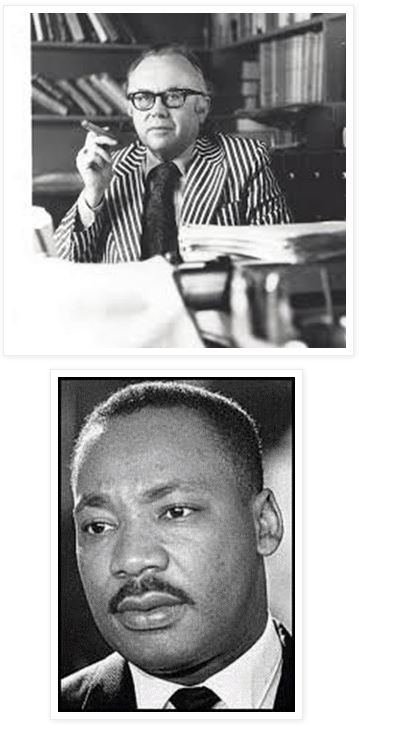
The latest outrage of this revolutionary “cleansing” of traditional conservatism has been what has been inflicted on Russell Kirk, the “Sage of Mecosta,” the generally acknowledged founder of the American conservative movement back in the early 1950s. And it comes at the behest and invitation of the very institution bearing his name, The Russell Kirk Center for Cultural Renewal, which plans to host a joint conference with the Acton Center, on Monday, January 16, with black activist John Woods, Jr., doing the honours. Under the looming visage of Abe Lincoln, Woods’ Web site, Braver Angels, defines his own organization as dedicated “to depolarization…bridging the partisan divide….” (A photo of a gaggle of brainless, lovey-dovey, googly-eyed Clinton and Trump supporters decorate the site.)
Here is part of the blurb from the Kirk Center:
Without King and Kirk, modern American Social Justice liberalism and modern American conservatism as we know them would not exist. And yet, for all of their differences, our modern politics suffer because contemporary liberalism and conservatism often lack the grounding in virtues, communitarian values and faith in an ordered universe to which both Kingian Nonviolence and Kirkian Conservatism held fast. Is it possible that by reacquainting ourselves with these lost traditions we could summon the better angels of left and right and restore a politics of virtue for the modern age?
Outrage is too mild a term to use to describe this inane barbarity. It is built on lies and blatant falsehood.
At one time figures such as Kirk were considered too unwieldly, too untouchable to be incorporated into the swirling vortex of crazed conservative political correctness. Very simply, although the standard encomia were regularly paid to his earlier accomplishments and role, his essential (negative) views on King, his opposition to the civil rights movement (and legislation), his staunch arguments against egalitarianism, his opposition to the frenzied anti-colonialism of the 1950s and 1960s (cf., his adventure novel, A Creature of the Twilight, set in late colonialist Africa), and his virulent disgust directed at George H. W. Bush (which led him to become chairman of Pat Buchanan’s campaign in Michigan in 1992, just as I chaired the North Carolina Buchanan effort) are significant mileposts which Kirk biographer, Bradley Birzer, must acknowledge (see generally, Birzer, Russell Kirk: American Conservative; University of Kentucky Press, 2015).
From 1967, when I was a college freshman, until shortly before his death in 1994, I corresponded frequently with Russell. As chairman of the Pfeiffer University Visiting Lecture Program—that would never happen today!—I brought him to my school. And, then, after a year as a Thomas Jefferson Fellow at the University of Virginia (where I finished my MA in 1971), Kirk asked me to come to Mecosta to serve as his assistant for 1971-1972. There I was privileged to learn from the Master. Not only did I delve deeply into roots of traditional Anglo-American conservatism (I assisted RK on Eliot and His Age and The Roots of American Order), but one responsibility I had was to edit Kirk’s little educational quarterly, The University Bookman. There he demonstrated his willingness, among other difficult topics, to debate cognitive disparities between the races (publishing reviews of politically-incorrect volumes).
And then, I recall sitting in his library with him as the results of the Michigan Democratic presidential primary filtered in, in the spring of 1972. Although television sets and radios were not permitted in the old house, “Piety Hill,” up the street, I had a radio, and at Russell’s urging I brought it down from my room (the second floor of the library building). Kirk delighted in George Wallace’s upset victory, although I don’t think he wished his wife Annette to find out!
Such examples of his thinking and actions are now all swept under the carpet, carefully ignored, or simply rewritten, and the “Sage of Mecosta” emerges with new raiment, diminished and stuffed in a Procrustean bed, fully “trans-ed” and purified of his earlier inequities and sins of racism and against “human rights.”
Let us recall a little history, and this I essentially repeat from my earlier essays on this subject to which I refer the reader.
Mention the fact that King may have plagiarized as much as 40 % of his Boston University Ph.D. dissertation [cf. Theodore Pappas, Plagiarism and the Culture War: The Writings of Martin Luther King, Jr, and Other Prominent Americans, 1998, and Martin Luther King Jr Plagiarism Story, 1994, if they are have not been scrubbed from circulation], or that he worked closely with known Communists throughout his life, or that he advocated American defeat in Vietnam while praising Ho Chi Minh, or that he implicitly countenanced violence and Marxism, especially later in his life [cf., Congressional Record, 129, no. 130 (October 3, 1983): S13452-S13461]—mention any of these accusations confirmed begrudgingly by his establishment biographers David Garrow and Taylor Branch, or mention his even-by-current-standards violent “rough sex” escapades (which apparently involved even under-agers) [cf., Cooper Sterling, January 13, 2018, VDare] and you immediately get labeled a “racist” and condemned by not just the zealous King flame-keepers on the Left, but by such “racially acceptable” conservatives like Rich Lowry and Dinesh D’Souza who supposedly are on the Right.
Indeed, in some ways Establishment “conservatives” such as Lowry (National Review), D’Souza, Glenn Beck, the talking heads on Fox and the furious scribblers at nearly all major “conservative” journals, and many others, not only eagerly buy into this narrative, they now have converted King into a full-fledged, card-carrying member of “conservatism inc.”—a “plaster saint” iconized as literally no one else in our history. Thus, this latest attempt to “scrub” clean Russell Kirk so that he, too, can join the new holy pantheon…finally, it simply had to happen.
Celebrating King becomes a means for the modern “conservative” movement to demonstrate its “civil rights” and “egalitarian” bona fides. When the Neoconservatives made their pilgrimage from the Trotskyite Left into the ranks of conservatism in the 1960s and 1970s, they brought with them a fervent belief in a globalist New World Order egalitarianism that characterized their Trotskyite ideology, and the determination to redefine and re-orient the traditional American Rightwing, and to re-write, as well, American history.
Thus, the purges of the old conservative movement in the 1980s and 1990s—there was no room for Southern conservatives like Mel Bradford, no room for traditionalist Catholics like Frederick Wilhelmsen or Brent Bozell Sr., no room for paleo-libertarians like Murray Rothbard, no room for Old Right anti-egalitarians like Paul Gottfried, and no room for “America Firsters” like Pat Buchanan…. These figures did not believe in King’s (and Lincoln’s) “promise of equality,” and thus were no doubt scarred by latent or real racism.
King Day becomes, then, for the modern Conservative Movement an opportunity for it to beat its chest, brag about its commitment to civil rights and “the American dream, the unrealized idea of equality” (that is, to distort and re-write the history of the American Founding), and to protect its left flank against the ever increasing charges that it could be, just might be, maybe is —“racist.”
The heavily-documented literature detailing the real Martin Luther King is abundant and remains uncontroverted. During the debates over establishing a national “King Day” in the mid-1980s, Senators Jesse Helms and John East (both North Carolinians) led the opposition, supplying the Congress and the nation, and anyone with eyes to read, full accounts of the “King legacy,” from his close association and collaboration with the Communist Party USA to his advocacy of violence and support for the Communists in Vietnam, to implicit support for Marxist revolution domestically. Ironically, it was Robert Woodson, a noted black Republican, who highlighted in a lecture given to honor the “conservative virtues of Dr. Martin Luther King” at the Heritage Foundation on November 5, 1993, the difficulties in getting black advocates of the older generation to respect King’s role as a Civil Rights leader. According to Woodson, as quoted in an excellent essay by Paul Gottfried,
…when Dr. King tried to bring the Civil Rights movement together with the [Marxist] peace movement, it was Carl Rowan who characterized King as a Communist, not Ronald Reagan. I remember being on the dais of the NAACP banquet in Darby, Pennsylvania when Roy Wilkins soundly castigated King for this position. [Paul Gottfried, “The Cult of St. Martin Luther King – A Loyalty Test for Careerist Conservatives?” January 16, 2012].
But not only that, behind the scenes there were voluminous secretly-made FBI recordings and accounts of King’s violent sexual escapades, often times with more than two or three others involved in such “rough sex” trysts; and of his near total hypocrisy when discussing civil rights and other prominent civil rights leaders. It is, to put it mildly, a sorry record, scandalous even by today’s standards…Indeed, King makes Harvey Weinstein look like a meek choirboy in comparison.
But you won’t hear any of that mentioned by the falling-all-over-itself media mavens at “Conservatism Inc.” or on Fox. In fact, such comments will get you exiled to the far reaches of the Gobi Desert and labeled a “racist,” quicker that my cocker spaniel gobbles down his kibble.
Almost all the material is now available and accessible online, including material from the Congressional Record. And I have listed it in previous forays into this topic. Much of what we really have come to know is thanks to the excellent work and dedicated research of the late Dr. Sam Francis, who served on the staff of Senator East. Francis’s work is critical, and originally was written to preface the publication of voluminous testimony and documentation placed in the Congressional Record by Senator Helms.
Francis’s essay and the Helms’ dossier were eventually published in book form (I have a published copy, but I’m unsure if you can still find it on Amazon). A few years back Dr. Francis’s introduction [“The King Holiday and Its Meaning,” February 26, 2015] and the lengthy Congressional Record material, which he prepared for Helms [“Remarks of Senator Jesse Helms. Congressional Quarterly,” February 26, 2005] were put online. For a very complete understanding of King’s association and cooperation with American Communists and his endorsement of Vietnamese Communism, as well as his putative endorsement of Marxism here in the United States while condemning the free enterprise system, these two items are essential reading.
But, say the scribblers at the “establishment conservative media,” wasn’t King really a conservative at heart, an old-fashioned black Baptist who believed in the tenets of traditional Christianity? Shouldn’t we simply overlook these all-too-human failings? And, like John Woods, Jr., shouldn’t we search diligently for those points of “consensus” and “shared communitarian values”?
The answer is a resounding NO.
I can think of no better summation of the real meaning of King Day and its bare-knuckled ideological use to deconstruct, dissolve and obliterate American traditions and heritage than to cite, again, Sam Francis:
“[T]he true meaning of the holiday is that it serves to legitimize the radical social and political agenda that King himself favored and to delegitimize traditional American social and cultural institutions—not simply those that supported racial segregation but also those that support a free market economy, an anti-communist foreign policy, and a constitutional system that restrains the power of the state rather than one that centralizes and expands power for the reconstruction of society and the redistribution of wealth. In this sense, the campaign to enact the legal public holiday in honor of Martin Luther King was a small first step on the long march to revolution, a charter by which that revolution is justified as the true and ultimate meaning of the American identity. In this sense, and also in King’s own sense, as he defined it in his speech at the Lincoln Memorial in 1963, the Declaration of Independence becomes a “promissory note” by which the state is authorized to pursue social and economic egalitarianism as its mission, and all institutions and values that fail to reflect the dominance of equality—racial, cultural, national, economic, political, and social—must be overcome and discarded.
“By placing King—and therefore his own radical ideology of social transformation and reconstruction—into the central pantheon of American history, the King holiday provides a green light by which the revolutionary process of transformation and reconstruction can charge full speed ahead. Moreover, by placing King at the center of the American national pantheon, the holiday also serves to undermine any argument against the revolutionary political agenda that it has come to symbolize. Having promoted or accepted the symbol of the new dogma as a defining—perhaps the defining—icon of the American political order, those who oppose the revolutionary agenda the symbol represents have little ground to resist that agenda.”
I will not be celebrating this day; rather, it is for me a mournful reminder of what has happened and is happening to this country…and what has happened to the once-fearless and vibrant “conservative movement” and now to the revered Dr. Russell Kirk.
==========================================
~ DR. BOYD D. CATHEY Dr. Cathey earned an MA in history at the University of Virginia (as a Thomas Jefferson Fellow), and as a Richard M Weaver Fellow earned his doctorate in history and political philosophy at the University of Navarra, Pamplona, Spain. After additional studies in theology and philosophy in Switzerland, he taught in Argentina and Connecticut before returning to North Carolina. He was State Registrar of the North Carolina State Archives before retiring in 2011. He writes for The Unz Review, The Abbeville Institute, Confederate Veteran magazine, The Remnant, and other publications in the United States and Europe on a variety of topics, including politics, social and religious questions, film, and music. Dive into Dr. Cathey’s Barely A Blog archive and latest Hard Truth interview.