Category Archives: Private Property

Trust Republicans To Sabotage A Safe Return To Work

Business, COVID-19, Free Markets, Labor, Law, libertarianism, Private Property, Regulation, Republicans

“In the absence of clinical therapies or a vaccine for coronavirus, the successful return to work rests, very plainly, on the willingness of the citizenry to cover up, keep clean and keep a distance.” (“The Ethics of Social Distancing: A Libertarian Perspective.”)

If businesses want customers to resume consumption and workers to stay safe and productive on the job—they must, within reason, provide a safe working and shopping environment.

The market incentivizes business to protect customers and employees and thus to also reduce the spread of COVID. If business acts recklessly, customers will stay away. And if companies place workers in a precarious position, then the worker who gets sick on the job generally has recourse through litigation.

The free-market and the law—more so than government regulation—provide corrective mechanisms to ensure workers and customers are safe. Government regulations are generally agreements between industrial special interests and the state. Duly, they mostly benefit those interests alone.

By removing the incentives aforementioned,  so necessary in a society based on ordered liberty, the government sabotages a safe return to work, as it fails to allow corrective mechanisms to work.

Trust the Republicans, then, to strive to remove the incentives for business to fit the workplace for success in the age of coronavirus.

To hell with the desperate young worker, who toils in a crowded, unclean, meatpacking facility, currently a “serious vector for the pandemic.”
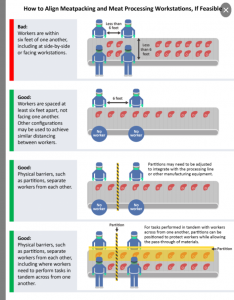
Or, the flight attendant who was told by the airline she’d be fired if she wore a mask. If they get sick on the job because their employers refused to set up and suit up for COVID—the worker will have no recourse, courtesy of the Republicans’ liability protection guarantees.

With half of all U.S. states forging ahead with strategies for easing restrictions on restaurants, retail and other businesses shuttered by the coronavirus crisis, business groups have been pushing for protection against COVID-19-related lawsuits …The Trump administration is also pushing for liability safeguards … [Reuters]

GOP lawmakers have warned that without additional protections they believe business owners will be too fearful of litigation to reopen.

McConnell, during an interview with Fox News on Tuesday, called the extra protections his “red line.”

“Let me make it perfectly clear, the Senate is not interested in passing a bill that does not have liability protection. … What I’m saying is we have a red line on liability. It won’t pass the Senate without it,” he added.

Stripped of baffle-gab, this means that Republicans wish to shield business from the consequences of reckless disregards for the safety of shoppers and workers. For the courts will examine cases on their merit, and throw them out if they are frivolous.

Fail to allow corrective mechanisms like litigation to work—and you’ll increase illness, death and poverty and spread more devastation.

* Thanks, Scott Olson | Getty Images, for fair use.

@ Unz Review.

UPDATED (7/22/019): NEW COLUMN: Do We Still Have A Country? Part I

English, Homeland Security, IMMIGRATION, Individual Rights, Individualism Vs. Collectivism, Law, Nationhood, Natural Law, Private Property, Racism

NEW COLUMN, on Townhall.com, is “Do We Still Have A Country? Part I.” It’s accompanied by an abridged YouTube clip.

An excerpt:

How do you know you don’t have a country?

Simply this:

Every single passive, non-aggressive act you take to repel people crossing your borders is considered de facto illegal, or inhumane, or in violation of international law, or in contraventions of some hidden clause in the U.S. Constitution.

So say the experts and their newly minted jurisprudence.

You may tell a toddler, “You can’t go there.” But you may not tell an illegal trespasser, “Hey, turn back. You can’t come into the U.S. at whim.”

Please understand that not giving someone something they demand or desire is a negative act. Or, more accurately, an inaction.

You are not actively doing anything to harm that person by denying them something.

Unless, of course, what you are denying them is their right to their life, their right to their liberty, their right to their property. Those are the only things you may not deny to innocent others. These interlopers do not have a right to, or a lien on, your liberty and property.

But if you cannot say to millions of people streaming across your border, into your turf, “Hey, you can’t go there.” Then it’s simple:

We don’t have a country.

Oh sure, we have a territory. America is a market place for goods and services. A mighty one at that. It’s a market place to which millions arrive each year to make a living and engage in acts of acquisitiveness. ….

… READ THE REST. “Do We Still Have A Country? Part I” is on Townhall.com.

UPDATE (7/22/019): pointing out that language and civics knowledge are not required to pass the US citizenship test: that amounts to bashing. Are you sure it’s not also racist?

Trump, on the other hand:

Tower Of Babel:

Once upon a time:

California’s Centrally Planned Neighborhoods

Federalism, Founding Fathers, Private Property, Regulation

Think Americans still live in the decentralized republic the Founding Fathers bequeathed? Think  Americans benefit from a federal form of government, where control is local and residents get to decide about the character of the place they inhabit? Think again.

Consider California’s housing-supply law. If residents of a community don’t want to “develop” their corner of the world—if they wish to preserve the character of the place they call home—Big Brother Central Planner will make them.

Gavin Newsom, California’s new governor, is  suing “Huntington Beach, a coastal city in Orange County, for failing to comply with the state’s housing-supply law.”

California has a severe shortage of affordable housing, and he wants to bring a sense of urgency to the problem. The state has the highest poverty rate in America when adjusted for the cost of living. One-third of renters pay more than half of their income towards rent, and homeownership rates in the state are at their lowest level since the 1940s.

The lawsuit against Huntington Beach is meant to be a warning shot to cities that they cannot stonewall development. Fifty years ago the state passed a “housing element” law requiring communities to plan for new housing for all income groups, based on forecasts for population growth. In 2017 the state legislature passed several bills to speed up housing development and approvals. Until recently many cities have not met their housing numbers but faced little consequence …

MORE: “Why California’s governor is suing Huntington Beach: Can a lawsuit compel upscale cities to build more housing?

UPDATED (4/3/019): The American Dream? Forget The White Picket Fence And The House

Business, Economy, Globalism, IMMIGRATION, Labor, Nationhood, Private Property

CBS News:

Even with rising wages and falling mortgage rates, Americans can’t afford a home in more than 70 percent of the country. Out of 473 U.S. counties analyzed in a report, 335 listed median home prices more than what average wage earners could afford, according to a report from ATTOM Data Solutions. Among them are the counties that include Los Angeles and San Diego in California, as well as Miami-Dade County in Florida and Maricopa County in Arizona.

Naturally, realtors prefer a tight housing market driven, in part, by an unending influx of immigrants:

… swaths of America have seen local housing fundamentally altered by an influx of new immigrant groups—sometimes in surprising ways that fly in the face of prevailing narratives.

There are now about 42 million immigrants from just about every country in the world living in the U.S., making up about 13% of the overall population, according to the National Conference of State Legislatures. They’re a wildly diverse group, but they’re bound by a common desire: to build a better life for themselves and their families.

“Immigrants are a big driving force for housing markets across the nation,” says Kusum Mundra, an economics professor at Rutgers University, Newark. “Most want the American dream, which is to own a home.”

UPDATES (4/3/019): Kushner vs. Deplorables:

Deplorables: