
Category Archives: Ancient History

‘Are We Rome?’ Was A Question Asked and Answered Long Ago

Ancient History, Government, Iraq, libertarianism, Military, Taxation, The State, War

To the hackneyed question, ‘Are We Rome?’, John Stossel replies, “Not yet.” He is completely wrong, just as he was wrong to dismiss the “National Security Administration tracking patterns in our emails and phone calls,” to quote.

Mr. Stossel takes comfort in the fact that “we don’t kill people for sport. When we go to war, misguided or not, we don’t conquer or plunder. And when we win, we usually leave.” (July 18, 2013)

Who is he kidding? The US hunts down and kills very many innocents abroad by drone. It’s a bit of a sport—so much so that decadent New Rome has even established a “new medal that honors drone pilots and computer experts” for their long-distance killing prowess.

Courtesy of Uncle Sam, war-time slaughter has just been industrialized, streamlined, made more efficient in our times.

Compare the demographic and economic indices of countries the US has invaded—for their own good, of course, but without their consent—before and after the “merciful” intervention. You’ll get a better idea of the carnage than John Stossel allows.

Libya is no longer. Ditto Iraq. Afghanistan is not doing much better since Rome set up camp there.

Read “Casualties of the Iraq War.”

Read “Civilian casualties in the War in Afghanistan (2001–present).”

Read “Deaths caused by Coalition forces” in Libya.

Again, contrary to the Stossel assertion, the latter-day Rome has mechanized the warfare-state’s killing and has refined its propaganda wing to an art—so fine an art that John Stossel has bought it hook, line, and sinker.

No-one attempting to tackle the ‘Are We Rome?’ question should be allowed to get away with failing to mention Cullen Murphy’s book by that name. This is a question that was asked and answered already. Superbly.

A 2010 column I wrote highlighted “the unflattering parallels between the imperial rule of ancient Rome and that of modern America,” as illustrated in Murphy’s book, “Are We Rome? The Fall of an Empire and the Fate of Rome.”

The federal payroll in Washington Murphy pegs at 360,000 (BO: Before Obama), calling this estimate a “convenient deceit,” as an “even larger number of people in the Washington area — about 400,000 — work for private companies that are doing government work.” Add to the above a quarter million people who live in the vicinity and feed off the government directly or indirectly; the lawyers and lobbyist, the wonks and accountants, the reporters and caterers and limousine drivers and panegyrists, and all the aides and associates whose job it is to functions as someone else’s brain.”
Don’t forget that the D.C. hood is home to your favorite oh-so gritty media personalities, who gather inside or near the Bubble to reap “the benefits of being at the center of the Imperium.” Back to their role model, Rome:
The biggest component of [Rome’s] prodigious intake was something called the annona, an in-kind tax levied by Rome on everyplace else, and collected in the form of grain, which was used to provide free bread for most of Rome’s inhabitants. … Eventually, the annona was expanded beyond grain to include olive oil and wine. If you think of the annona as tax revenue, which it was, then the revenue not only accomplished its stated purpose of feeding the city; it also supported large swaths of private-sector activity, from shipping to baking to crime. Some of this activity was encouraged with tax breaks and grants of citizenship. There was great wealth to be had off government contracts. … the annona remained [the Empire’s] essential lifeline, preserved at all costs.
“All life in Washington today derives ultimately from the capitals’ own version of Rome’s annona — the continuous infusion not of grain and olive oil but of tax revenue and borrowed money. Instead of ships and barges there are banks, 10,000 of them designated for this purpose, which funnel the nations’ tax payments to the city. This ‘never-ending flow of revenue creates a broad level of affluence that has no real counterpart anywhere in America.” Says Murphy: “Washington simply doesn’t look like the rest of America.” But its residents “fail to view this as bizarre.”
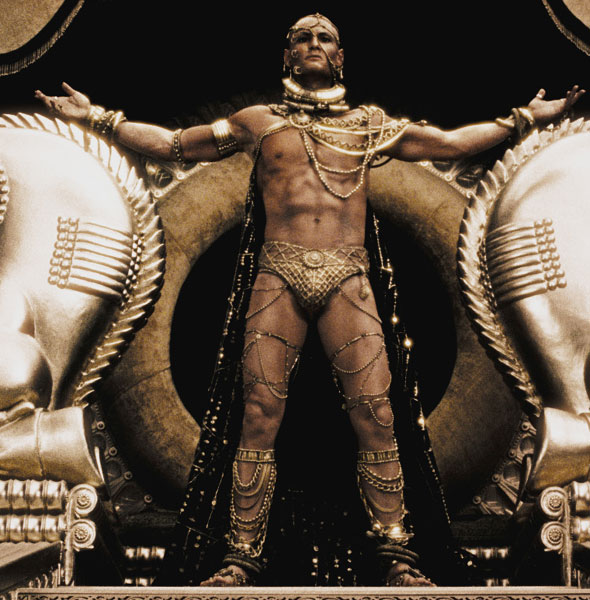
UPDATED: Xerxes Is On The Move

Africa, Ancient History, Barack Obama, Celebrity, Government, South-Africa

At a cost of “between $60 million to $100 million,” “President Obama goes to sub-Saharan Africa this month,” reports the usually adoring Washington Post. A good part of the comitatus“‘the sprawling apparatus’ that encompasses … the emperor’s household and its personnel”—is going along for the ride.

Xerxes_1275455993

The obscene details via The WaPo:

Military cargo planes will airlift in 56 support vehicles, including 14 limousines and three trucks loaded with sheets of bullet­proof glass to cover the windows of the hotels where the first family will stay. Fighter jets will fly in shifts, giving 24-hour coverage over the president’s airspace, so they can intervene quickly if an errant plane gets too close.
The elaborate security provisions — which will cost the government tens of millions of dollars — are outlined in a confidential internal planning document obtained by The Washington Post.

This ugly extravaganza is par for the course—and grounds well covered in Cullen Murphy’s book “Are We Rome? The Fall of an Empire and the Fate of Rome,” in which Murphy draws the unflattering parallels between the imperial rule of ancient Rome and that of modern America.

The First Family will be stopping in our former hometown of Cape Town. (As if the FLOTUS has not already propagandized from South Africa, during a 2011 trip. Inoculate yourself. Read “Clueless in South Africa With Mrs. Obama.”)

UPDATE (6/14): In case you forgot who Xerxes was, read “‘300’: Defending Civilization Can Be Messy.”

A Burning Dilemma Among America’s Dhimma

America, Ancient History, Barack Obama, Bush, Ethics, History, Islam

“A Burning Dilemma Among America’s Dhimma” is the current column, now on WND. An excerpt:

… While dhimmis contemplate what to do with the decaying corpse of a Muslim mass murderer, consider what General Sir Charles James Napier counseled about the valiant defense of Western values. The general (on an admittedly imperial mission to India) was confronted with the local Hindu practice of Sati, “the custom of burning a widow alive on the funeral pyre of her husband.”

When “Hindu priests complained to him,” as Wikipedia tells it, “about the prohibition of Sati by British authorities,” Napier replied:

“Be it so. This burning of widows is your custom; prepare the funeral pile. But my nation has also a custom. When men burn women alive we hang them, and confiscate all their property. My carpenters shall therefore erect gibbets on which to hang all concerned when the widow is consumed. Let us all act according to national customs.”

In the West, we do not dispose of the dead on open-air funeral pyres, as is still done in India, Bali, south of Indonesia, and Nepal. But we do cremate. Cremating Tamerlan Tsarnaev’s remains is commensurate with what ought to be American values: It conserves resources and leaves (almost) nothing behind.

Incinerate Tsarnaev’s corpse. It’s the moral thing to do.

It matters not that “Islam strictly forbids cremation.” True Christians and Jews forbid the murder of innocents. Those are the values that trump Islam.

Besides, Islam is a highly derivative (and distorted) belief system. Tamerlan believed that “the Bible was a cheap copy of the Koran.” However confused Muslims like him are about historical chronology, they do claim to accept the Ten Commandments, bequeathed in the Hebrew Bible’s Exodus and Deuteronomy, centuries before Muhammad. If so, the Sixth Commandment is unequivocally clear: “Thou shalt not kill.”

He who kills innocents has forfeited his right to religious burial rites—especially if these are to be administered by the killer’s victims. …”

The compete column is, “A Burning Dilemma Among America’s Dhimma.” Read it on WND.

If you’d like to feature this column, WND’s longest-standing, exclusive paleolibertarian column, in or on your publication (paper or pixels), contact ilana@ilanamercer.com.

JOIN THE DISCUSSION, AND DO BATTLE FOR LIBERTY BY:

Using the content-sharing icons on Barely a Blog posts.

At the WND Comments Section, and on Facebook.

By clicking to “Like,” “Tweet” and “Share” WND’s “Return To Reason.”

UPDATE II: CNN Leads The Day’s ‘News’ With Death Of A … Mouseketeer (Margaret Thatcher’s Magnificent Mind)

Ancient History, Britain, Conservatism, Economy, Education, Feminism, Free Markets, Gender, History, Journalism, Media, Propaganda, Reason

The one and only Iron Lady, Margaret Thatcher, passed away today of a stroke. She was 87. CNN led its piss-poor hourly programing—activism, really—with news about the death of mouseketeer Annette Funicello.

What comes immediately to my mind is that Margaret Thatcher stood for the gradualism of Ronald Reagan, when it came to delivering South Africa to the sainted Nelson Mandela’s communists. As noted on page 147 of “Into the Cannibal’s Pot: Lessons for America from Post-Apartheid South Africa”:

…public intellectuals … thought nothing of delivering South Africa into the hands of professed radical Marxist terrorists. Any one suggesting such folly to the wise Margaret Thatcher risked taking a handbagging. The Iron Lady ventured that grooming the ANC as South Africa’s government-in-waiting was tantamount to ‘living in cloud-cuckoo land.’

Tell me that fools are not attempting to redefine, à la postmodernism, the very definition of news. And why not? Academics have similarly broken down the ancient concept of the intellectual discipline.

“Intellectual disciplines,” historian Keith Windschuttle has written, “were founded in ancient Greece and gained considerable impetus from the work of Aristotle who identified and organized a range of subjects into orderly bodies of learning. … The history of Western knowledge shows the decisive importance of the structuring of disciplines. This structuring allowed the West to benefit from two key innovations: the systematization of research methods, which produced an accretion of consistent findings; and the organization of effective teaching, which permitted a large and accumulating body of knowledge to be transmitted from one generation to the next.” (The Killing of History, Keith Windschuttle, Encounter, pp. 247-250)

Failing to lead the news with coverage of Mrs. Thatcher’s passing is in-itself big news.

UPDATE I: MSNBC’s odious Martin Bashir, a Briton, is dismembering Thatcher. His correspondent’s source of analysis: Meryl Creep’s depiction in “The Iron Lady.”

As I said, disciplinary breakdown.

Of course, many of Thatcher’s moves I‘d oppose, however it is undeniable that she was perhaps the only true great female leader other than old Golda Meir. I cannot think of a woman with a Thatcher-like intellect in international politics. Golda didn’t have that intellect, but she was quite the character. Both were nothing like today’s whiny, idiot fems.

UPDATE II: Don’t bother searching the articles penned by the presstitutes in the UK and the US, about Baroness Thatcher. Her remarkable oratory they call simple—to these cretins plain-spoken reason is counter-intuitive and hence, simplistic. The so-called 10 best quotes from Mrs. Thatcher’s are really stupid things said about her by her intellectual inferiors in Labor.

Here is Mrs. Thatcher displaying that incisive intellect of hers:

“…What the honorable member is saying is that he would rather the poorer were poorer, provided the rich were less rich.”

Watch the above bit of parliamentary flyting as only the British can do, and tell me the woman was not brilliant. Even her opponent delights in her retort.

“I detest every one of her domestic policies,” the Member tells the PM. To which she replies without flinching, in that crisp beautiful English:

“The honorable gentleman knows that I have the same contempt for his socialist policies as the people of East Europe who’ve experienced it have.”

On the famous U-Turn:

“For those waiting with bated breath for that favorite media catch phrase the U-Turn, I have only one thing to say: ‘You turn if you want to. The lady’s not for turning.'”

The exchange below with the pompous Peter Mansbridge of CBC is particularly relevant to the empty talk about “compromise” infesting current debates:

What perturbs Peter Mansbridge, a Canadian institution in his own right—a stuffy, ossified, yet rather able lefty journo—is what he calls “the uncompromising style of Thatcherism.” A liberal doesn’t like a debate about substance, for it demands intellectual argument. Rather, the liberal is compelled to make silly points about style for those allow for an emotional approach (“Baroness, you make me feel bad; you hurt my self-esteem”).

Mrs. Thatcher offers up a gorgeous metaphor for the pursuit of truth: “When you’re starting a journey over the seas, you steer by stars that are always the same in the heavens. If you haven’t any stars to steer by, then it’s a pretty nondescript journey. …consensus doesn’t seem to be a very good star to steer by.”

Exquisite.

And Mrs. Thatcher’s coup de grâce: “Why are you so interested in compromise and consensus? Why are you not interested in having clear objectives; and having been elected on clear objectives, knowing full-well that the difficulties would emerge first and the benefits later?”