Category Archives: Psychology & Pop-Psychology

UPDATED (4/20): Rest In Peace, Prince Philip; Burn In Hell Meghan Markle

America, Britain, Celebrity, Family, Psychology & Pop-Psychology

Bide your time, lovely Kate Middleton, Duchess of Cambridge. You’ll be queen one day, a beautiful and benevolent queen, and then you can dispatch the manipulative and malevolent schemer, Meghan Markle, to The Tower of London (“Mighty fortress. Royal palace. Infamous prison”), if she dare set foot in England.

It’s time for the royals to reclaim the moxie of Queen Elizabeth I (1533–1603).

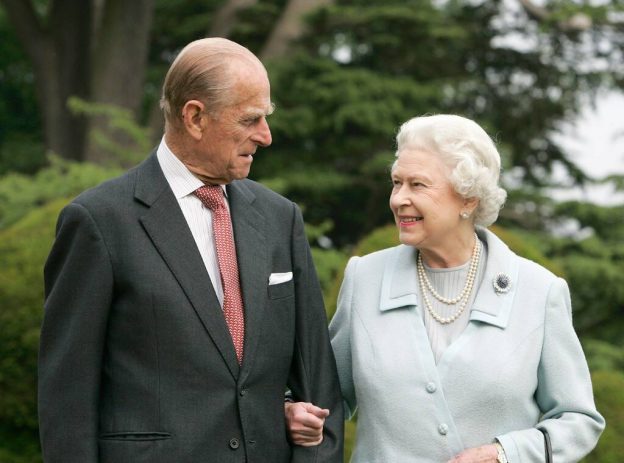
This hopeful exhortation comes against the backdrop of the passing of “Prince Philip, the Duke of Edinburgh, at the age of 99, [which] marks both a moment of personal grief for the Queen and the royal family and a moment of national mourning for a man who dedicated his life to public service.”

Prince Philip had been teetering when Markle gave her performance with the Queen of Kitsch, Oprah Winfrey. Meghan Markle’s sordid little Oprah psycho-drama dwarfs, in this context. She has shown herself as a tacky, tawdry, Hollywood c-list actress, who is a disgrace to the decent Americans.

In 2017, I had predicated, too hastily, that Meghan Markle, American actress, would finish what Diana Spencer had begun: destroy the Monarchy. Markle was a divorced, left-liberal feminist out of Hollywood. It screams degeneracy. She’s pathologically manipulative, too. The signs were there. Check out video footage I posted then of the Child Snake.

When Markle erupted, the cretins of American media proved too corrupt and stupid to look at the bare-bones of reality: who was doing the trashing, dividing and bad-mouthing? ‘Twas trashy Meghan Markle.

Peddling hearsay: That was Meghan Markle, who’s turned her houseboy on his family, the monarchy. The latter are refined, something trash-bag Markle doesn’t get. Even if the Queen and her family thought “improper” thoughts about her, they’d never express them.

Incidentally, Markle’s narcissism is not a mental disorder, it needs no diagnosis; it’s a fault and a flaw. Over this space, we do not medicalize bad, ugly behavior. That lefty mode of thinking is another erroneous thinking adopted by conservatives from the Left. Evil is not an illness.

A brother comes out with it: That empty suit, Meghan Markle, has unleashed insignificance on an anguished world, says “Suits” co-star Wendell Pierce. Well said. That’s narcissism, now isn’t it? Foisting your solipsistic, inconsequential self on the cosmos.

The queen won’t outlive Meghan Markle, but she dwarfs that ditz.

Comparing Biden (sadly dim) and Queen Elizabeth (sharp), as she conducts a Zoom call with The Kingdom, Mark Steyn performed brilliant satire on the Tucker Carlson Show, calling the Queen—read about some of her feats in “Mobocracy Vs. Monarchy“—Bret Baier in a tiara.

Heartfelt condolences, your Majesty.

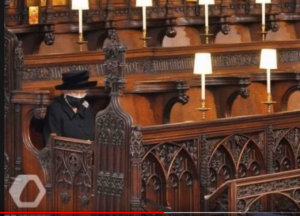
UPDATED (4/20): No wonder we get on so well, David. Not a redundant word in this YouTube. And no milquetoast words, either. I liked “vile” for the specter of the great lady, The Queen, alone in the pews.  A picture paints a ….
UPDATED (3/6) NEW COLUMN: AOC’s Coven of Spitting, #MeFirst Cobras Comes To Congress

Argument, Critique, Culture, Democrats, Donald Trump, Etiquette, Feminism, Gender, Government, Left-Liberalism And Progressivisim, Psychology & Pop-Psychology

NEW COLUMN is “AOC’s Coven of Spitting, #MeFirst Cobras Comes To Congress” is now on WND.COM, The Unz Review, Townhall.com and the great American Greatness.

The column debuted on CNS.News.

Excerpt:

The media scrum framed the Trump impeachment circus, round two, as an “emotional” affair.

Headlines homed in on the “emotion” surrounding the trial. “It Tears at Your Heart. Democrats Make an Emotional Case to Senators — and America — Against Trump,” blared one of many hackneyed screamers, this one from Time.com.

The case made by the managers “was both meticulous and emotional,” came the repetitive refrain.

Democrat Jamie Raskin, a representative from Maryland and a lead impeachment manager, sniffed “emotionally” as he related what to him was a heartbreaking tidbit: His (privileged) daughter expressed fear of visiting the Capitol again, presumably because of the January 6 fracas. That made Jamie cry. And when Jamie Raskin cries, normies outside Rome-on-the-Potomac laugh. Uproariously.

Impeachment managers had warned all present in the Senate Chamber that evidentiary footage would be upsetting. Their presentations were “intentionally emotional,” intoned CNN’s Dana Bash, who had paired up with one Abby Phillips for the “solemn” affair. Phillips’ “coverage” of all things Trump, in scratchy vocal fry, was a reminder that the Left’s “empaneled witches and their housebroken boys are guided more by the spirit of Madame Defarge than by lady justice.”

A lady in an armadillo outfit emoted a lot. She was impeachment manager Stacey Plaskett. Although not particularly fashionable or feminine, there was a ton of “emotional” praise on the Internet for Plaskett’s attire. Armani’s armadillo apparel was certainly a preferred distraction to the decibels of weepy rage emitted over the Trump protest.

The “intentionally emotional” affair, the last impeachment trial conducted by the Senate, had been preceded by an even more “emotionally” bizarre “healing” coven in Congress, led by the representative from New York, one Alexandria Ocasio-Cortez.

Ocasio-Cortez set up an hour-long primitive, ritualistic session conducted, putatively, to purge the pain over the January 6 protest on the Capitol.

Early in February, a coven of “prominent Democratic lawmakers, including Reps. Ayanna Pressley (Massachusetts) and Rashida Tlaib (Michigan),” joined Ocasio-Cortez in forcing such a session, with the aim of “creating space for members to talk about their ‘lived experience’” during that Capitol Hill riot.

Big League Politics, a news website, was incredulous, reporting that “congress [had] devolved into an AOC-led therapy session,” during which “House members cried while detailing their ‘lived experiences.’”

This American “thought” leader, Ocasio-Cortez, and her “harrowing” ordeal dominated the corporate press as well.

Here are some of the histrionic headlines as to what befell Congress’s queen of #MeFirst solipsism.

See if you can spot the operative word that animated the writers’ impoverished text:

“AOC reveals more personal details in new harrowing video …”

“AOC shares harrowing Capitol riot experience, reveals she’s a victim of …”. …

… READ THE REST.

NEW COLUMN is “AOC’s Coven of Spitting, #MeFirst Cobras Comes To Congress” is now on WND.COM, The Unz Review, Townhall.com, on CNS.News, and the great American Greatness.

UPDATED: It’s All So Emotional: The Origins Of Our Degenerate, Therapeutic Culture

Christianity, Culture, Pop-Culture, Pseudo-intellectualism, Pseudoscience, Psychiatry, Psychology & Pop-Psychology, Religion

The media scrum had framed the Trump impeachment circus round II as an “emotional” affair.

Over and over again did the word “emotion” inform reporting, appear on the lips of legislators,  and culminate in an “emotional” catharsis in the Chamber, where the “affected” representatives told a captured audience how they suffered.

Where did this sick therapeutic culture originate? Where else but in America.

I recalled reviewing a book, in 2005, when London’s Jewish Chronicle was a serious magazine. What a relief it was, then, to learn that Jewish thinkers didn’t herald the therapeutic age, a fact that emerges from Andrew Heinze’s outstanding Jews and the American Soul.

In his examination of “why [between 1890 and 1945] psychology became a booming cultural industry, outstripping theology and philosophy as a guide for a literate mass audience seeking advice on how to live”, Andrew Heinze, a scholar, established that “America’s Protestant heritage yielded a powerful American interest in personal development and a massive audience for popular psychology”.

The rationality of the Enlightenment had come under fire from movements espousing mysticism, romanticism, and the occult. The ascendancy of “the psychological interpretive mode” between the 1880s and the 1920s was compatible with Christianity.

The new psychotherapies “had the drama of faith-healing”; the new psychotherapists, true to their Protestant heritage, spread the faith with evangelical zeal.

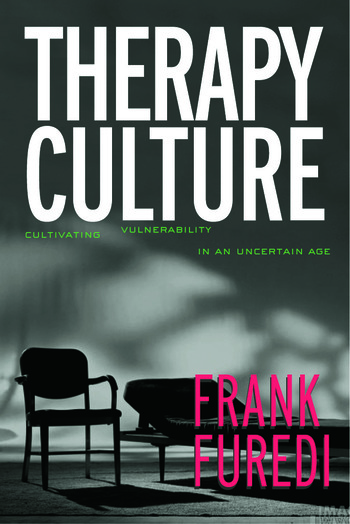
What do you know? In searching for an image to accompany this blog post, I came across what looks like a work of scholarship that affirms the Anglo-American origins of these leanings as well as the coercive, manipulative nature of the “therapeutic imperative”:

Therapy Culture explores the powerful influence of therapeutic imperative in Anglo-American societies. In recent decades virtually every sphere of life has become subject to a new emotional culture. Professor Furedi suggests that the recent cultural turn toward the realm of the emotions coincides with a radical redefinition of personhood. Increasingly vulnerability is presented as the defining feature of people’s psychology. Terms like people ‘at risk’, ‘scarred for life’ or ’emotional damage’ evoke a unique sense of powerlessness. Furedi questions the widely accepted thesis that the therapeutic turn represents an enlightened shift towards emotions. He claims that therapeutic culture is primarily about imposing a new conformity through the management of people’s emotions. Through framing the problem of everyday life through the prism of emotions, therapeutic culture incites people to feel powerless and ill. Drawing on developments in popular culture, political and social life, Furedi provides a path-breaking analysis of the therapeutic turn.

UPDATED: A fair point is made by our reader in the Comments Section. I am, however, making a philosophical, or theological, point about Judaism as opposed Christianity. Judaism is more legalistic. The supernatural, mysticism, romanticism, and the occult are more compatible with Christianity than with the rationalist morality of Judaism.


Outsourcing Life To The Expert Class: The Menace Of The Managerial Class

COVID-19, Family, Government, Outsourcing, Psychiatry, Psychology & Pop-Psychology, The State

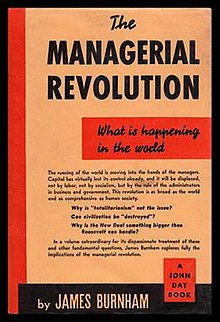
In James Burnham’s Managerial State, explains , “political power moves away from … institutions like Congress and toward the executive bureaucracy … The effect is the reduction of nonmanagerial political institutions to increasingly nominal status. Forms of ‘constitutionalism’ may still be permitted to exist, but the managerial elite does not derive its power or legitimacy from them. It can, therefore, easily manipulate or simply ignore these institutions while pursuing its own ends.”

The managerial elite has given us our dysfunctional, atomistic, fragmented society, where traditional support systems no longer exist. To pick up the slack we have the Expert Class.

In a way, the insidious Expert Class that shapes and manages perceptions about public affairs is an extension of the Managerial State. The expert class tends to remove moral and medical decisions from individuals, families, and communities of faith by medicalizing problems of living.

Once, big-on-the-military actor James Wood got word about a veteran who was about to shoot himself in some remote location. So he galvanized the … experts. He got him “help.” He outsourced the problem.

Most people need community, not therapy.

The reason people are desperate and depressed is not because they don’t have a suicide hotline’s number handy or an AA support group buddy; but because they are bereft of family and community.

This simplest of logical deductions we are no longer even able to arrive at without outsourcing thinking to the generators of empirical evidence, the expert class.

Here is that “doh!” factor, confirmed by The Economist in, “A pandemic of psychological pain: How to reduce the mental trauma of covid-19″:

Humans are resilient. Those who experience trauma mostly cope. When their homes are destroyed by earthquakes, they rebuild them and carry on. Even the mass bombing of cities in the second world war did not break civilian morale. Nonetheless, the world should take the collective mental damage of covid-19 seriously. Steps to reduce it cost little, and can benefit not only individuals but also society more broadly.

Research into previous disasters suggests that survivors’ long-term mental health depends more on “perceived support” than “received support”. In other words, donations of money or food matter less than the feeling that you can turn to your neighbours for help. Such help is typically offered spontaneously, but governments can also chip in. France, for example, sets up “medical and psychological emergency units” after terrorist attacks and other disasters. These try to minimise the long-term mental-health consequences of such events by offering immediate walk-in psychological support near the site of the disaster. Several cities in France have reactivated this “two-tent model”, one for medical care and the other for mental care, to help people cope with the toll of the virus.

Some people draw comfort from the fact that they are not alone—millions are facing the same tribulations at the same time. But the pandemic also presents unusual challenges. No one knows when it will end. Social distancing makes it harder to reconnect with others, a step in recovering from trauma. And the economic shock of covid-19 has undermined mental-health services everywhere, but especially in poor countries.

The most important measures will be local. A priority should be bringing people together by, say, expanding internet access. Mutual-aid networks (eg, WhatsApp groups to deliver groceries to the elderly), which tend to peter out once the initial disaster subsides, should instead be formalised and focused on the most vulnerable. Mental-health professionals should connect patients to such services, and train more lay folk as counsellors. In Zimbabwe, well before the pandemic, hundreds of grandmothers were taught how to provide talk therapy on village benches to depressed neighbours who could not afford to visit a distant clinic. Such innovations can work elsewhere, too.