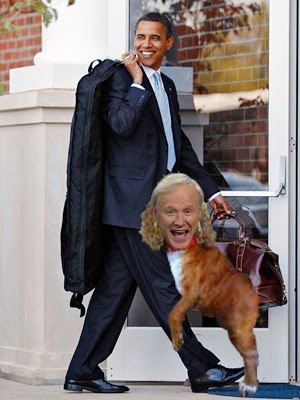
Among the mindless monolith that is our media some are more mindless than others.
At MichelleMalkin.com, Doug Powers reports on the Media Research Center’s Obamagasm Awards.
The winner is no other than MSNBC’s Chris Matthews, for, as Doug put it, achieving “simultaneous Obamagasms with his guests.”
In my 2010 take, I credited Matthews’ for his prolonged state of heightened arousal over BHO (multiple Obamagasims):
MSNBC’s Chris Matthews has more street cred than most. The host of “Hardball” spent the first two years of the Obama presidency in a state of delirium bordering on the sexual. Famous for experiencing something akin to a (daytime) nocturnal emission during Obama’s coronation — “thrill up the leg” Matthews called the incident — Chris later begged Barack to be his “Enforcer,” in the matter of sacking Gen. Stanley McChrystal. Understand: when a liberal like the president shows a bit of that manly magic, “girlie boys” like Chris get giddy.
Given Chris’s well-known carnal affections for Barack Obama, it is unfortunate that the op-ed segment with which he ends the “Hardball” program daily is called “Let Me Finish.”
Chris certainly attained climactic levels of devotion to the Dear Leader.
“Tingles” deserves a life-time award in Obama adulation.
You Know You’re a GUN CONTROL HYPOCRITE IF….
You consistently call a magazine a clip
You think an AR 15 is an assault rifle
You have armed security guards
You are in possession of an illegal magazine while arguing gun control on national television
Your kids have armed security guards
Your kids’ school has 11 armed security guards
You think a .223 is a military round
You think the thing that goes up is a barrel shroud
Your husband used to sell crack
Your husband raps about crack
When you hear the words “fast and furious,” you think, “Oh, great movie.”
You rule a country where a large part of the city from which you originated is a killing zone, even though no one is allowed to carry a firearm.
You’ve never held a gun.
You’ve never shot a gun
You’ve never read the Second Amendment and looked beyond the mere words on the paper. …
“If you’ve ever carried concealed, if you’re Piers Morgan, if you own a knife, if you live in a gated community—anyone in the “Demand a Plan” video—the first thing out of your mouth when you heard about the Sandy Hook shooting was gun control.”
You own a gun-free zone establishment.
You drafted an assault-weapon’s ban but you carry concealed.
You think the NRA is the KKK.
…If you’ve ever used a gun in a movie.
If you don’t know the difference between a high-capacity magazine and a standard capacity magazine
You think hollow-points are cop killer bullets.
You think there’s a gun-show loophole.
Everything you know about guns is from TV and movies. You think cops are expert gunmen.
[SNIP]
If you ask me, hypocrisy is too soft and imprecise a word for the detritus of humanity described by Brother “Noir.”
UPDATE I (12/31/012): LOTT LOSES. Piers Morgan refuses to allow guest John Lott to speak to the issue of statistical murder rates and gun ownership. But then Dr. Lott does not try to make a point, now does he? Meek and ineffectual is the word when it comes to to the so-called right and its defense of rights.
MORGAN: National handgun ban. And it was incredibly effective. Australia, the same thing.
Now, John Lott, your answer is more guns makes America safe, even though you look at the statistics, you have 300 million in circulation and you have the worst gun murder rate of any of the wealthy countries of the world by a massive multiple.
How do you justify the claim more guns makes more safe people in America? I don’t — don’t get it. JOHN R. LOTT, JR., AUTHOR, “MORE GUNS, LESS CRIME”: Every place that guns have been banned, murder rates have gone up. You cannot point to one place, whether it’s Chicago or whether it’s D.C. or whether it’s been England of whether it’s been Jamaica or Ireland… MORGAN: That’s a complete lie. LOTT: It is not! MORGAN: It’s a complete lie! MORGAN: The gun murder rate in Britain is 35 a year average! LOTT: Do you understand… MORGAN: You need to stop repeating a blatant lie about what happened in other countries! LOTT: Look, sir… MORGAN: Thirty-five gun murders a year… LOTT: You don’t — you… MORGAN: No, you’re not going to get away with this! LOTT: No! Just one… MORGAN: You lied about it the other day! LOTT: Sir…
MORGAN: Thirty-five gun murders a year in Britain, 11,000 to 12,000 in America! LOTT: You… MORGAN: Stop… LOTT: No! You don’t even understand simple math! MORGAN: What you say drives Americans… LOTT: Can I explain something… MORGAN: … to go and buy weapons… LOTT: Well, there’s a difference between… MORGAN: … to defend themselves! LOTT: … saying something’s low and that it increased. What I say is there’s lots of reasons why murder rates differ across countries. But when a ban is put on, it still may end up being lower than someplace else, but it went up!
What’s so difficult about quickly interjecting a word about the meaningless of absolute murder numbers, absent other demographic data such as total population, where crime is concentrated and clustered—its racial and urban vs. rural complexion, etc.
The equal opportunity idiocy on Piers Morgan continues. “The 2nd Amendment didn’t take into account assault weapons,” says purveyor of pop spirituality, DEEPAK CHOPRA.
When they passed the 2nd Amendment, they had muskets. It took 20 minutes to load one, and half the time, you missed, OK? The 2nd Amendment didn’t take into account assault weapons, the fact that you can buy them through the secondary market or you can load up on ammunition through the Internet.
So, by logical extension, should the 1st Amendment also be contingent on the extent to which technologies can be used to the detriment of some? During the Founding, I presume, there were no megaphones or loudspeakers. Is Chopra implying that as offensive speech got louder and more easily transmitted, the Founders would have reconsidered the right to free speech? Regulated the Internet? Is anyone suggesting that had the framers, some of whom were inverters, foreseen today’s technological innovations, they’d have written a different document?
Of course that’s what’s implied by a statist like Chopra, whose inspiration is eastern mambo-jumbo, not John Locke.
The Bill of Rights is a document of individual liberties, setting limits on government, not a document meant to recalibrate individual liberties in light of each era’s technological innovations.
UPDATE III (1/2/2013):Hollywood whores. When are you going to boycott their pathetic products?
Cuts to designated increases in federal spending: that’s all the “spending cuts” or “budget sequestration” portion of the fiscal cliff cadenza amount to.
These cuts were mandated by a law, The Budget Control Act of 2011, enacted by our miserable legislators. They now refuse to abide by this meager law.
The media, lying simpletons that they are, are framing the government-cutting component of the fiscal free-fall as a catastrophe.
Whoever believes that cuts to the rate of government growth would be catastrophic should fry.
For good measure, the same mind-fucking media are using phrases such as “Congressional stubbornness” as proxies for Republican recalcitrance.
The next component in the fiscal-cliff equation, or The Budget Control Act of 2011, are tax hikes. The Bush tax cuts will sunset, as will the temporary payroll tax cuts and certain tax breaks for businesses. Also to take effect are taxes tied to President Obama’s health-care behemoth.
As I understand it, in addition to their refusal to consider any cuts in spending rates, Democrats are insisting on replacing the tax raising provisions of the law with tax hikes on The Rich.
The mindless masses (and the pea brains of Hollywood), however, are already against Congress, which, for all its timidity also stands accused, preemptively, of failing to raise “the national borrowing limit.”
What are the Democrats doing? Put in Charlie Sheen speak, they are “Winning.”
*Cadenza: South African informal for a fit or convulsion
UPDATE (12/29/012):‘Cuts’ In Spending-Rate Increases.
Finally, Republicans and a couple of Democrats and their anointed experts are framing all budget proposals out there as they should: “cuts to designated increases in spending.”
With the government spending roughly $10 billion a day, the cuts that are being proposed wouldn’t even cover the interest on the debt.
Spending is not projected to go down. At best, the rate of growth in spending would slow.
“The word ‘cut’ is what government statisticians and budget officials call it — but in fact it’s just really a slowing of growth, and sometimes the growth is still quite high even after it’s slowed down,” said John Taylor, a Stanford University economist.
“They assume that if this year we spend 5 percent, next year we’re gonna spend 8 percent, and the year after that we’re gonna spend 10 percent. And they say ‘well I’ll tell you what, why don’t we cut a percentage point off each one of those rates of growth?’ … Well, that’s not a cut.”
Former Democratic Sen. Evan Bayh noted that “no family, no business, no philanthropy” would operate that way.
“I think there are some passages in Alice in Wonderland that must have dealt with this, because in Washington less of an increase is considered a cut, even though it’s more money…”
KAREN DE COSTER: … It’s … amusing to see how often “essential” and “grains” are used together, and no, grains aren’t essential for robust health. For starters, they are not nutrient dense. Additionally, they are loaded with carbohydrates, hence their addiction. For many people, it’s not much different than eating sugar. When considering the importance of the three macronutrients – carbohydrates, protein, and fat – carbs are the only one not essential to sustain life.
Yet grains are cheap thanks to the existence of powerful political-business alliances robbing taxpayers to redistribute booty to Big Agra. To counter the anti-white attack of earlier years (white potatoes, white flour, white rice), the whole grain campaign was created. The government and its assorted offshoots – grain lobbies and national nutritional organizations in cahoots with the medical establishment – ramped up the crusade to brainwash consumers on the whole grain question. The Whole Grains Council still uses the slogan “Eat Grains at Every Meal.”
Unfortunately, people are still walking around in the fog of the unknown, believing that whole grains are, as you noted, “essential” for life and health. The government-Big Agra alliance established grains as the foundation of the federal food pyramid, and since that time we have witnessed 30+ years of mounting obesity and the prevalence of modern disease. The industrial food system is churning out a zillion gimmick products to leverage the pro-grain propaganda, and the marketing whizzes excel at throwing simplistic slogans at consumers through advertising channels. Still, people order wheat bread in restaurants, and most of it is nothing more than white bread with caramel coloring added. And they don’t have a clue! They think they are making the “healthy” choice. Other breads are labeled “whole grain,” but they only contain a portion of whole grain flour. Understandably, people are confused by the terminology of wheat, whole wheat, and whole grain. Most of this market is very deceptive.
Not only are grains not essential, but it’s also important to remember that grains can be destructive to some people. We have not evolved to eat grains, and some people cannot adapt to grains without suffering adverse health effects. Furthermore, grain eaters become sugar burners instead of fat burners, and then they can’t understand why they keep getting fatter on their “healthy” diet. Another point that most people don’t understand is that modern wheat is not your grandfather’s wheat. Modern wheat has been cross-bred and hybridized many times through the years, so its molecular structure has taken a drastically different form.
Grains contain anti-nutrients (gluten, lectin, phytic acid), and our bodies cannot break down these anti-nutrients. That is why many traditional foodies will soak, sprout, and ferment grains, even though those traditional methods don’t necessarily make grains a whole lot more digestible.
MERCER: What did you cook for your Christmas feast?
DE COSTER: Pastured ham from a half hog that came from Melo Farms, my pork/chicken farmers. The pig led a happy pig life, spending her days foraging the pasture and eating organic supplements. Probably something made out of fresh-grown yams, too. I get them from a local farmer who is not a big government certified organic, but he doesn’t spray and he applies organic methodology. Lastly, Brussels sprouts are a great early winter vegetable here in Michigan. I have a huge stalk fresh-picked. For drink, I get fresh-made Michigan apple cider (Honeycrisp apples) from Hy’s Cider Mill. I make drinks with the cider, local honey, cinnamon, nutmeg, and perhaps something to “spike” it up.
If you’d like to feature this column, WND’s longest-standing, exclusive paleolibertarian column, in or on your publication (paper or pixels), contact ilana@ilanamercer.com.
JOIN THE DISCUSSION, AND DO BATTLE FOR LIBERTY BY: